Warehouse AI
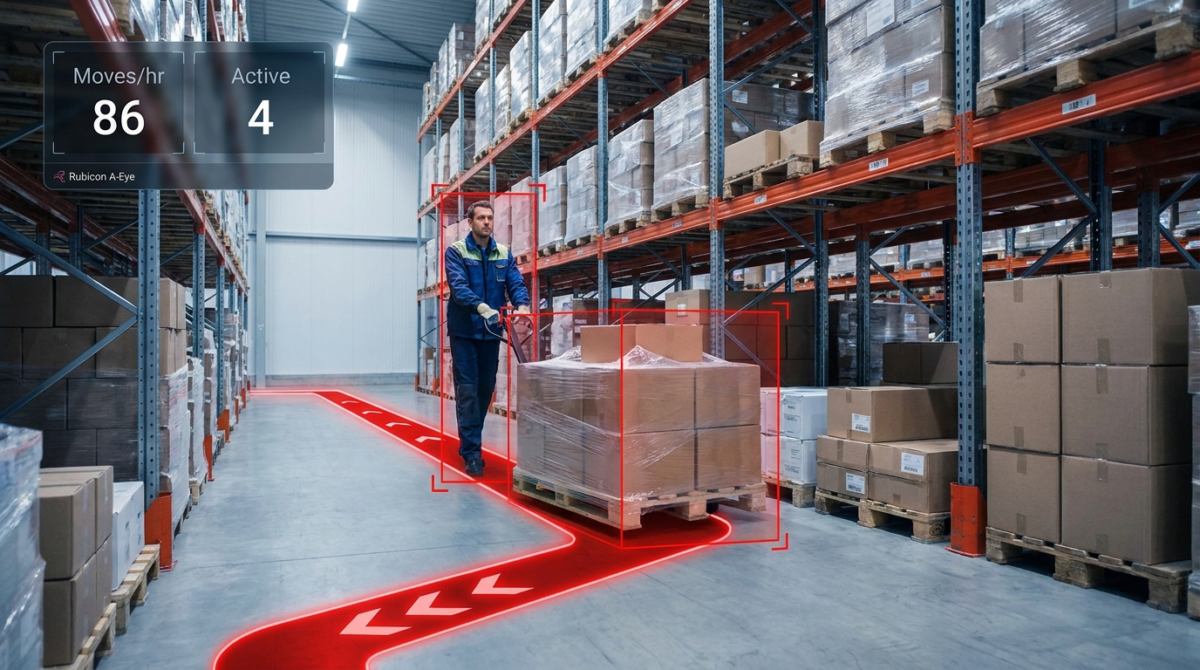
Stock does not just sit in a warehouse — it moves, constantly, between receiving, storage, picking and dispatch. Every move that happens without being recorded pulls your system away from reality. Rubicon A-Eye tracks goods movement between zones in real time, so flow is visible and unrecorded moves are caught as they happen.
The business challenge
Warehouse accuracy erodes in the gaps between transactions. A scan records that stock arrived and a scan records that it shipped, but in between it is moved, re-slotted, consolidated and picked — often without a corresponding system entry. Each unrecorded move is a small divergence between what the system believes and what is physically true, and they accumulate into the discrepancies that counts later expose.
Beyond accuracy, managers rarely have a clear view of how goods actually flow through the building. Without that, bottlenecks, congestion and inefficient travel go unmeasured and unaddressed. The typical pains:
- Stock moved between locations without a system transaction
- Discrepancies that appear at count time with no traceable cause
- No visibility of where flow slows or congests during the day
- Shrinkage and losses that cannot be investigated after the fact
- Inefficient travel and double-handling that nobody can quantify
- Disputes over what happened to specific stock, with no record to consult
The hidden cost of invisible movement
Unrecorded movement is expensive in two distinct ways. First, it is the single largest source of the inventory drift that erodes accuracy between counts — and inaccurate inventory causes service failures and wasted capital. Second, because movement is the work of the warehouse, inefficiency in how goods travel is inefficiency in your whole operation: every metre of unnecessary travel and every instance of double-handling is labour spent for no output. When movement is invisible, neither of these costs can be managed — they are simply absorbed, shift after shift.
How Rubicon A-Eye solves the problem
A-Eye observes movement between the zones you define — receiving, staging, storage, picking, dispatch — and builds a live picture of how goods travel through the facility. When stock moves between zones, the movement is captured; when it moves in a way that bypasses the system, that gap can be flagged for reconciliation.
This turns movement from an invisible process into measurable data. You can see flow in real time, identify where it slows, and keep a visual record of how goods travelled — useful both for resolving disputes and for investigating shrinkage. As always, processing runs on-site at the edge, so footage stays in the building and only movement data is shared.
Connected to Odoo, observed movements can be reflected as internal transfers, closing the loop between physical flow and system records that manual processes leave open. The system stops drifting because the physical reality is continuously feeding it, and managers gain a flow map they can use to redesign work for less travel and congestion.
Key capabilities
Zone-to-zone tracking
See goods move between defined areas of the warehouse in real time, with origin and destination logged.
Unrecorded-move detection
Flag movements that happen without a corresponding system transaction, so they can be reconciled the same day.
Flow & bottleneck visibility
Identify where movement slows or congests so you can rebalance work and protect cut-off times.
Visual audit trail
Maintain a record of how stock travelled for disputes, investigations and process reviews.
Shrinkage support
Improve accountability by making removals and movements traceable rather than invisible.
Transfer reconciliation
Feed movements into Odoo as internal transfers to keep positions accurate automatically.
What you can measure
Making movement visible creates a set of flow metrics managers have rarely had access to:
- Movement volume between zones over time
- Unrecorded moves detected and reconciliation response times
- Bottleneck locations and the periods they occur
- Discrepancy reduction attributable to earlier detection
- Travel and double-handling patterns for layout review
- Time-to-resolve for stock investigations and disputes
Industry applications
Movement tracking is valuable in any operation where stock changes hands and location frequently inside the building:
High-throughput operations such as e-commerce fulfilment gain from the flow and bottleneck visibility, where small efficiency gains compound across thousands of moves. High-value operations — electronics, pharmaceuticals — gain most from the accountability and audit trail, where the cost of a single loss is high. In both cases, the cost of lost accuracy or efficiency is exactly what movement tracking addresses.
Business benefits
- Fewer inventory discrepancies through earlier detection of unrecorded moves
- Clear visibility of flow and bottlenecks for process improvement
- Stronger accountability and support for shrinkage investigations
- An auditable record that resolves disputes quickly
- More accurate Odoo positions through reconciled transfers
- Reduced double-handling and inefficient travel
How it works: the operational workflow
Example scenarios
Closing an accuracy gap before count day
Stock is consolidated from two locations into one during a quiet period, but the transfer is never keyed. A-Eye records the move between zones and flags the missing transaction, so the system is corrected the same day instead of showing a phantom shortage weeks later.
Result: a discrepancy prevented rather than discovered.
Relieving an afternoon bottleneck
Flow data shows goods consistently backing up between picking and dispatch in the late afternoon. The team adds a second staging lane during peak hours, smoothing the flow and protecting cut-off times.
Result: dispatch deadlines protected by acting on measured flow.
Investigating a shrinkage event
A high-value item is found missing. Because A-Eye holds a movement record, the team can trace how and when the stock last moved between zones, focusing the investigation instead of guessing.
Result: faster, evidence-based investigation.
Redesigning a wasteful pick path
Movement data reveals pickers repeatedly crossing the warehouse between two frequently-paired zones. Slotting is adjusted to bring those items closer together, cutting travel on every order that includes them.
Result: labour saved on every affected order, every day.
Implementation and rollout
Movement tracking deploys on your existing cameras and follows the same low-disruption path as the rest of Warehouse AI:
We start by mapping the zone boundaries that matter to your operation, then tune detection and validate it against known movements before connecting events to Odoo. You can begin with monitoring and reporting only, and enable automatic transfer reconciliation once you are confident in the data.
Integration with your systems
| System | How A-Eye connects |
|---|---|
| Odoo ERP / Inventory | Observed movements reflected as internal transfers to keep stock positions accurate. |
| Warehouse management (WMS) | Physical movement data complements scan transactions and surfaces gaps. |
| Dashboards | Live flow and bottleneck views for supervisors. |
| Reporting systems | Movement, flow and discrepancy metrics for operational reporting. |
Why visibility of movement changes how the warehouse runs
Most warehouse improvement effort goes into the things that are easy to see — receiving throughput, pick rates, dispatch cut-offs. Movement between those points is harder to observe, so it is rarely measured, and what is not measured cannot be improved. Yet movement is where a large share of warehouse labour is actually spent: travelling, re-slotting, consolidating and handling. Making it visible does not just protect inventory accuracy; it exposes the single biggest pool of recoverable labour in the building.
Once managers can see how goods flow, decisions that were previously guesswork become evidence-based. Slotting can be arranged so frequently-paired items sit close together. Staging can be sized to real peak volumes. Congestion points can be relieved before they threaten cut-off times. None of these are dramatic, one-off projects — they are continuous, compounding improvements that are only possible once the flow is no longer invisible. This is the difference between a warehouse that is managed on outputs and one that is managed on the work itself.
Sizing staging to real demand
A supervisor suspects the outbound staging area is undersized but has no data to justify changing it. Movement tracking shows staging consistently overflowing during the late-afternoon peak while sitting empty mid-morning. With the pattern documented, the team reallocates space confidently and the afternoon crunch disappears.
Result: a layout change justified by evidence, not opinion.
Built for UAE and GCC warehouse operations
The UAE’s distribution and fulfilment operations are characterised by high throughput, multi-client facilities and demanding service-level commitments, especially across e-commerce, FMCG and re-export. In these high-velocity environments, stock moves constantly and the accuracy gap opens quickly — which is exactly where continuous movement visibility has the most impact. A-Eye runs on-site at the edge, keeping footage within the facility in line with UAE data-privacy expectations, and is built to handle the scale and pace of the region’s larger distribution centres.
Delivered by a team that also implements Odoo, movement tracking is connected to the ERP that runs the rest of the operation, so reconciled transfers and flow insight reach the systems where stock and labour are actually managed. For operations under pressure to do more through the same building, the ability to see and improve how goods move — rather than only how much arrives and ships — is a practical route to more capacity without more space.
Getting started
Most operations begin with a short discovery call and a site assessment, in which we map the zone boundaries that matter, review camera coverage, and agree the flows worth tracking first. From there, A-Eye is configured to your facility, validated against known movements, and connected to Odoo for reporting — with automatic transfer reconciliation enabled once you are confident in the data. Because it builds on existing cameras and on-site processing, the path from assessment to live movement visibility is typically a matter of weeks, and you can start with a single high-traffic area before extending coverage across the building.
Frequently asked questions
Can it tell which zone stock moved to?
Does this help reduce shrinkage?
How is this different from inventory monitoring?
Does it track individual items or pallets?
Is footage stored off-site?
Can movements update Odoo automatically?
Will it work with our existing cameras?
Does tracking slow anything down?
How soon are unrecorded moves flagged?
Can we start with reporting before automating transfers?
Does it help with layout and slotting decisions?
What does it cost?
See how your stock really moves
Book a demo of real-time stock movement tracking and we will map it to your zones and Odoo.