

Warehouse AI
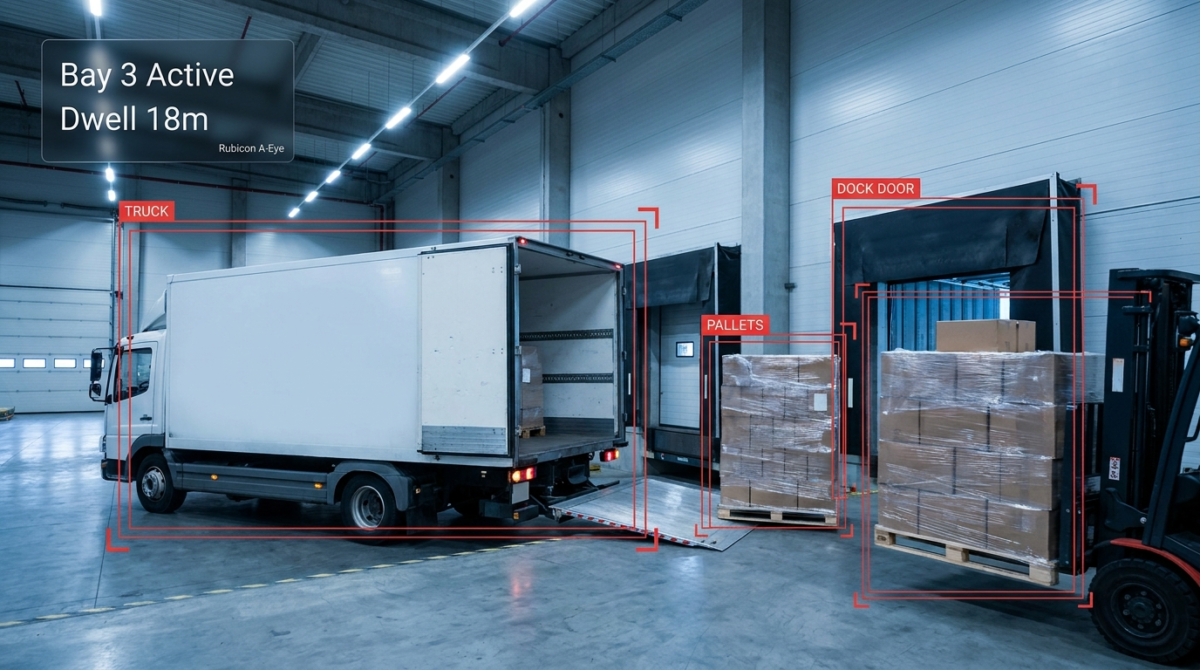
Dock doors are the throughput bottleneck almost every warehouse manager can feel but few can measure. Rubicon A-Eye watches every loading bay through the cameras you already have, turning dock activity, trailer presence and turnaround time into a live, continuous record instead of a guess made from the dispatch office window.
The business challenge
A loading bay is a fixed, expensive piece of infrastructure with a hard ceiling on capacity. Every site has a finite number of dock doors, and every door can only process one trailer at a time. Yet in most facilities nobody actually knows how those doors are being used. Supervisors know a dock is busy because they can see trucks queued at the gate, but they cannot say which bay caused the backlog, how long any individual vehicle actually sat at the door, or whether the same two bays are quietly absorbing most of the work while others sit idle for hours.
This blindness is not a minor inconvenience. Dock capacity is a shared constraint across inbound receiving, outbound dispatch, and any cross-dock or transfer activity, and whichever process is slowest to load or unload at a given moment determines how fast the rest of the operation can move. Without visibility into bay-level occupancy and dwell, planning is reactive: dispatchers assign bays from habit rather than data, gate staff wave trucks toward whichever door looks free, and nobody discovers a stalled vehicle until someone walks the dock or a driver calls to complain.
Day to day, this produces a familiar set of frustrations for whoever runs the yard and the dock:
- Trucks queued at the gate while some bays sit empty because nobody can see which doors are actually free
- No reliable record of how long a specific trailer occupied a specific bay
- Delays discovered only when a driver or transporter complains, long after the bay was effectively wasted
- Bay assignment decisions made on habit and proximity rather than current occupancy
- Disputes with carriers over detention and turnaround time with no independent record to settle them
- No visibility into which bays, shifts or vehicle types are consistently slower, so the same bottlenecks repeat every day
The hidden cost of unmanaged dock activity
The direct cost of a slow loading bay is the lost capacity at that door — every extra hour a trailer sits is an hour that door cannot process another vehicle. But the larger cost is what happens upstream and downstream of the dock. Inbound delays push receiving and put-away later in the day, compressing the time available for those tasks before the next shift’s outbound wave begins. Outbound delays risk missed carrier pickup windows, late deliveries, and the detention or demurrage charges that carriers invoice when a vehicle is held beyond its free time. None of this shows up as a single line item; it shows up as a slowly worsening pattern of lateness, disputed charges and overtime that a manager can sense but rarely prove. Without a record of bay occupancy, every detention dispute is an argument about who remembers correctly, and the warehouse is always on the back foot.
How Rubicon A-Eye solves the problem
A-Eye treats each loading bay as a monitored zone rather than an anonymous piece of concrete. Cameras already covering the dock feed an on-site edge device that continuously reads whether a bay is occupied or empty, when a vehicle arrives and departs, and how long it remains in place. The result is a live occupancy state for every door, and a precise dwell-time record for every vehicle that uses it — captured automatically, with no scanner, gate ticket or manual log required.
Processing happens on a small computer inside your facility, not in the cloud. Video stays on site; only the occupancy states, arrival and departure events, and dwell durations leave the device, flowing into your dashboards and Odoo records. This keeps the system aligned with data-privacy expectations and avoids the bandwidth cost of streaming dock footage anywhere off-premise.
In practice this changes how a dock is run. A supervisor opens a dashboard and sees, at a glance, which of the facility’s bays are occupied, which are free, and which have a vehicle that has been sitting well past a normal turnaround. Bay assignment for the next inbound or outbound load becomes a decision based on what is actually free right now, not a guess shouted across the yard. And when a carrier disputes a detention charge, the dwell-time record settles the question in minutes instead of becoming a week of back-and-forth emails.
Key capabilities
Live bay occupancy
See in real time which dock doors are occupied, which are free, and which have just become available, across every bay on the dock.
Trailer presence detection
Detect the moment a trailer arrives at and departs from a bay, without relying on a gate log or manual entry into the dock board.
Dwell-time measurement
Capture exactly how long each vehicle occupies each bay, from arrival to departure, as an automatic and auditable record.
Overstay alerts
Flag bays where a vehicle has exceeded a defined dwell threshold so a supervisor can intervene before it becomes a missed pickup or a detention charge.
Bay utilisation breakdown
See which bays carry the heaviest load and which are underused, so dock assignment and scheduling can be rebalanced.
Turnaround visibility by shift
Compare average turnaround time across shifts, days and bay types to identify where and when the dock slows down.
What you can measure
- Occupancy state of every monitored bay, continuously, in real time
- Dwell time per vehicle, per bay, from arrival to departure
- Bay utilisation rate across the full dock and by individual door
- Overstay incidents against a defined turnaround threshold
- Turnaround time trends by shift, day of week and vehicle type
- Idle-bay time during periods when queued trucks were waiting at the gate
Industry applications
Loading bay monitoring matters wherever dock doors are a constrained resource and vehicle turnaround affects either cost or service. In the UAE and wider GCC, it is particularly valuable for:
For 3PLs running shared facilities, bay-level data settles detention disputes with carriers and supports client-facing service reports. In FMCG and cold chain operations, where vehicle turnaround speed directly affects product freshness and delivery windows, overstay alerts catch delays before they cascade. In high-volume distribution centres with a limited number of doors, utilisation data is the basis for deciding whether the answer to congestion is better scheduling or genuinely more dock capacity.
Business benefits
- Better visibility into which bays are actually free, improving dispatcher assignment decisions
- Faster response to overstaying vehicles before they become missed pickups or detention charges
- An evidence-based record for resolving carrier detention disputes
- Clearer picture of which bays, shifts or vehicle types are consistently slower
- Reduced reliance on someone physically walking the dock to check status
- A factual basis for deciding whether dock congestion needs better scheduling or more capacity
- Improved coordination between inbound receiving and outbound dispatch around shared bay capacity
How it works: the operational workflow
The path from a camera frame to a dispatcher’s decision is short and automatic, so dock status is always current rather than something pieced together from radio calls.
Example scenarios
Catching a stalled outbound trailer
A trailer assigned to Bay 4 for an outbound load has been stationary well past the typical loading window. A-Eye’s dwell tracking crosses the overstay threshold and raises an alert on the dispatch dashboard. The supervisor walks over and finds the loading crew was delayed by a separate task — the bay is cleared and the trailer departs before its pickup window closes.
Result: a missed carrier pickup avoided because the delay was visible the moment it crossed the threshold, not after the truck was already late.
Resolving a detention dispute
A carrier invoices the warehouse for four hours of detention on a delivery, claiming the trailer waited at the bay since early morning. The dwell-time record shows the trailer actually arrived at the bay two hours later than claimed and departed within the free time allowed. The invoice is corrected using the timestamped record, with no negotiation needed.
Result: a detention dispute settled with an objective record instead of a week of emails.
Rebalancing bay assignment during a peak wave
During a high-volume outbound wave, the dispatcher’s habit is to send every truck toward Bays 1 and 2 because they are closest to the office. The occupancy dashboard shows those bays consistently queued while Bays 5 and 6 sit idle. Assignment is rebalanced across all six doors, and the wave clears faster with no change in headcount or trucks.
Result: more loads processed in the same shift, from better use of existing capacity, not from more capacity.
Identifying a recurring slow shift
Turnaround data trended over several weeks shows that average dwell time at the dock during the night shift is well above the day shift on the same vehicle types. Management can now investigate the night-shift loading process specifically — rather than assuming the dock as a whole is simply slow — and a staffing adjustment closes most of the gap.
Result: a shift-specific bottleneck found and corrected, where it had previously been invisible inside an overall average.
Integration with your systems
Dock activity only changes how the operation runs once it reaches the people and systems making dispatch and scheduling decisions. As a certified Odoo partner and AI engineering team, Rubicon treats this connection as part of the solution, not an add-on.
| System | How A-Eye connects |
|---|---|
| Odoo ERP / Inventory & Logistics | Bay occupancy and dwell events update dispatch records and can trigger tasks when a vehicle overstays. |
| Yard & dock scheduling | Live bay-free status supports better assignment of incoming vehicles to the next available door. |
| Dashboards | Real-time occupancy map and dwell-time view for dispatchers and dock supervisors. |
| Reporting & carrier billing | Timestamped dwell records exported for detention reconciliation and management reporting. |
Frequently asked questions
Do we need new cameras over the dock?
How does it know a bay is occupied versus just a vehicle passing through the yard?
Can it tell us how long a specific trailer sat at a bay?
Does this replace our dock scheduling system?
Can we set different overstay thresholds for different bays or vehicle types?
Where is the video processed?
Can this data be used to resolve detention billing disputes with carriers?
Does it work at night or in low light?
How many bays can it monitor at once?
Will it integrate with our existing Odoo setup?
How long does implementation take?
What happens if a camera covering a bay goes offline?
See real-time loading bay monitoring on a dock like yours
Book a demo or a no-obligation site assessment and we will show A-Eye running against your bays and your Odoo.