

Warehouse AI
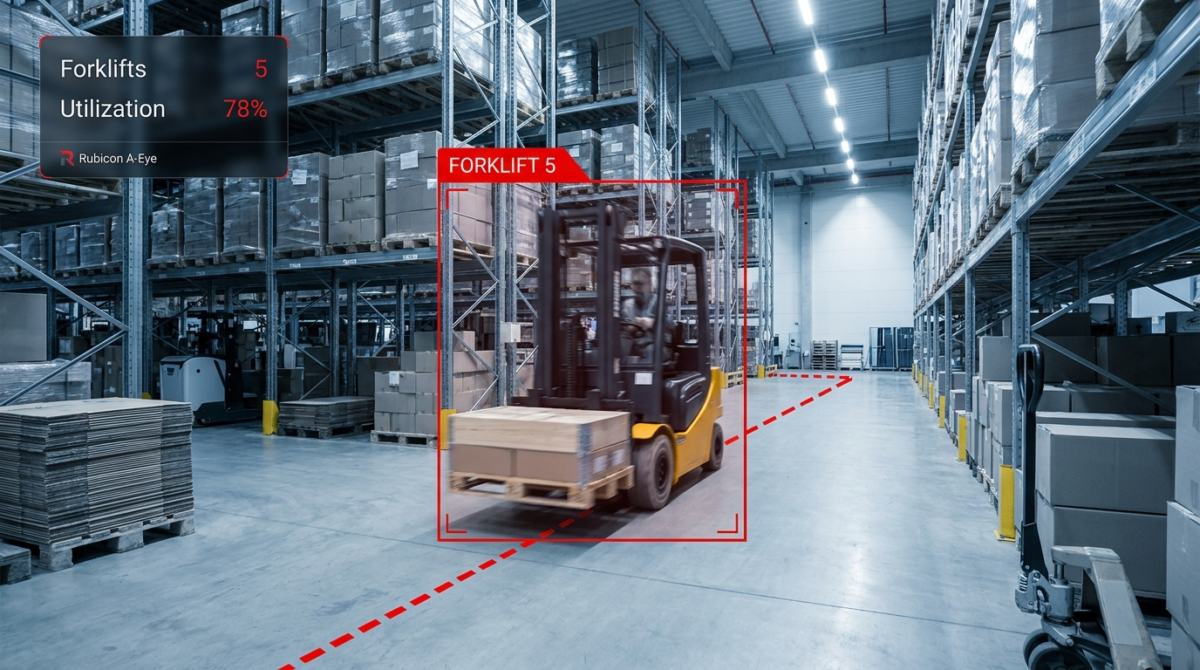
Forklifts are among the most expensive moving assets in a warehouse and the source of its most serious safety risk, yet most operations have no real visibility into how they are actually used. Rubicon A-Eye watches forklift activity, location and proximity to people through the cameras you already have, turning utilisation and safety into something you can see and act on, not something you infer after an incident.
The business challenge
A warehouse fleet manager typically knows how many forklifts the operation owns, what they cost, and roughly how many hours they are scheduled for — but very little about what actually happens between clock-in and clock-out. Forklifts sit idle between tasks, take inefficient paths across the floor, and operate in close proximity to pedestrians in aisles and dock areas, all without any record beyond what a supervisor happens to observe in passing.
This absence of data creates two separate but related problems. The first is operational: without visibility into actual utilisation, fleet sizing and shift planning are based on assumption rather than evidence, and it is impossible to tell whether congestion on the floor is caused by too few forklifts, poor routing, or simply uneven task allocation. The second is safety: forklift and pedestrian interactions are one of the most common sources of serious incidents in warehouse environments, and near-miss events — situations that almost became an incident but did not — go almost entirely unrecorded unless someone happens to witness one and chooses to report it.
Day to day, this shows up as a recognisable set of problems for warehouse and safety managers:
- No reliable data on how much of a forklift’s shift is spent actively working versus idle
- Fleet size and shift staffing decisions made on intuition rather than measured demand
- Near-miss incidents between forklifts and pedestrians that go unreported and unrecorded
- Congestion and inefficient routing on the floor that nobody can diagnose without watching the whole shift
- Safety incidents investigated after the fact with only witness accounts to reconstruct what happened
- No way to identify which zones of the warehouse carry the highest risk of forklift-pedestrian interaction
The hidden cost of unmonitored forklift operations
An idle forklift is a sunk cost that keeps accruing — lease or depreciation, maintenance, and the labour cost of an operator who is being paid regardless of whether the truck is moving. Multiplied across a fleet of several units over every shift, low utilisation that nobody can see or correct represents a meaningful and entirely avoidable cost. On the safety side, the absence of near-miss data means that risk patterns — a particular intersection, a specific time of day when forklift and foot traffic overlap most — stay invisible until an actual incident forces the operation to look. By then, the cost is no longer hypothetical: it includes injury risk, potential downtime, investigation time, and the liability exposure that comes from not having addressed a pattern that, with visibility, would have been obvious in advance.
How Rubicon A-Eye solves the problem
A-Eye treats forklift activity as a continuous operational and safety signal rather than something assessed only through periodic observation. Cameras already covering the warehouse floor, aisles and dock areas feed an on-site edge device that identifies forklift location, movement and idle periods, and detects proximity between forklifts and pedestrians in real time.
All processing happens on a device inside your facility. Video never leaves the site; only the operational data it produces — utilisation states, movement patterns, proximity events — flows onward to dashboards and, where relevant, Odoo. This keeps the system aligned with data-privacy expectations, and because the focus is on equipment activity and safety conditions rather than identifying individual operators, it supports an operational improvement programme rather than personal surveillance.
In practice, this gives supervisors two things they did not have before. First, a measured view of how the fleet is actually used across a shift — which units are active, which are sitting idle, and where time is lost to congestion or inefficient routing. Second, a live safety signal: when a forklift and a pedestrian come into close proximity in a zone where that should not normally happen, an alert is raised immediately, supporting intervention before a near-miss becomes an incident rather than analysis of an incident after it has already occurred.
Key capabilities
Forklift location tracking
See where each monitored forklift is operating across the floor at any point in the shift, without relying on radio check-ins.
Utilisation measurement
Distinguish active movement from idle time for each unit, building a real picture of fleet utilisation across a shift.
Near-miss zone detection
Identify situations where forklifts and pedestrians come into close proximity in shared aisles and crossing points.
Idle-time alerts
Flag units sitting idle for extended periods during active shifts, surfacing potential staffing or task-allocation issues.
Traffic flow visibility
See where forklift routes overlap, congest or take inefficient paths across the warehouse floor.
Operational safety reporting
Build a record of proximity events and high-risk zones to support a proactive safety programme rather than after-the-fact investigation.
What you can measure
- Active versus idle time for each monitored forklift across a shift
- Fleet-wide utilisation trends by shift, day and zone
- Near-miss proximity events between forklifts and pedestrians
- High-risk zones where forklift-pedestrian interaction occurs most often
- Routing and congestion patterns across the warehouse floor
- Idle-time incidents during periods of active task demand
Industry applications
Forklift monitoring matters anywhere powered material-handling equipment shares space with people and represents a meaningful share of operating cost. In the UAE and wider GCC, it is particularly relevant for:
For large distribution centres running multi-shift operations, utilisation visibility supports fleet sizing decisions that directly affect lease and maintenance spend. In any facility where forklifts share aisles with pickers and other foot traffic, near-miss detection targets the single highest-risk interaction on the floor. In operations with seasonal volume swings, utilisation data helps decide when extra units are genuinely needed versus when existing capacity is simply under-used.
Business benefits
- Evidence-based basis for fleet sizing and shift staffing decisions
- Earlier detection of near-miss situations before they escalate into incidents
- Reduced idle time through visibility into how the fleet is actually used
- Clearer picture of which floor zones carry the highest forklift-pedestrian risk
- A factual record to support safety programmes and incident investigations
- Better-informed routing and layout decisions based on observed traffic patterns
- Reduced reliance on after-the-fact witness accounts when investigating safety concerns
How it works: the operational workflow
The path from a camera view of the floor to a supervisor’s action is continuous, so utilisation and safety signals are available throughout the shift, not reconstructed afterward.
Example scenarios
Catching a near-miss before it becomes an incident
A forklift backing out of an aisle comes into close proximity with a picker who stepped into the crossing point without checking. A-Eye flags the proximity event in real time, and the supervisor reviews the footage that shift to identify that this specific intersection lacks clear sightlines. A mirror and a marked crossing are added.
Result: a recurring risk identified and corrected before it produced an actual injury.
Right-sizing the fleet during a quiet period
Utilisation data over several weeks shows that two of the facility’s six forklifts are idle for the majority of most shifts. Rather than renewing the lease on the full fleet, management reduces to five units and reallocates one operator to picking duties, with no measurable impact on throughput.
Result: lease and labour cost reduced using actual utilisation data instead of headcount assumption.
Diagnosing recurring floor congestion
Supervisors had long suspected that the intersection near the receiving dock caused delays during the morning wave, but could never prove it. Traffic-flow data confirms that intersection accounts for a disproportionate share of forklift stoppage time each morning. Re-routing one regular path around it reduces the congestion immediately.
Result: a long-suspected bottleneck confirmed and resolved with a routing change, not added equipment.
Supporting a safety investigation with objective data
A reported near-collision between a forklift and a pedestrian is investigated using the proximity event log from that shift, rather than relying solely on the two parties’ differing accounts. The record clarifies what happened and supports a specific, targeted correction to that zone’s traffic rules rather than a blanket policy change.
Result: an incident investigation grounded in an objective record instead of conflicting recollections.
Integration with your systems
Forklift utilisation and safety data delivers its value once it reaches fleet, safety and operations management directly. As a certified Odoo partner and AI engineering team, Rubicon connects this data into the systems you already run.
| System | How A-Eye connects |
|---|---|
| Odoo ERP / Inventory & Logistics | Utilisation and idle-time data informs labour and equipment planning alongside warehouse activity records. |
| Safety management | Near-miss and proximity events feed a structured safety record for review and programme planning. |
| Dashboards | Live utilisation map and safety event view for warehouse and safety supervisors. |
| Reporting systems | Fleet utilisation and safety-event trends exported for operational and management reporting. |
Frequently asked questions
Does this track individual operators?
Can it detect near-misses, not just collisions?
Do we need special cameras for this?
How does it measure utilisation versus idle time?
Can it help us decide if we need more or fewer forklifts?
Where is the video processed?
Can it identify high-risk zones in our warehouse?
Does this replace our existing safety programme?
How many forklifts can it monitor at once?
Will it work with our existing Odoo setup?
How long does implementation take?
What happens if a camera covering part of the floor goes offline?
See real-time forklift monitoring on a floor like yours
Book a demo or a no-obligation site assessment and we will show A-Eye running against your fleet and your Odoo.