

Food & Beverage Distribution AI
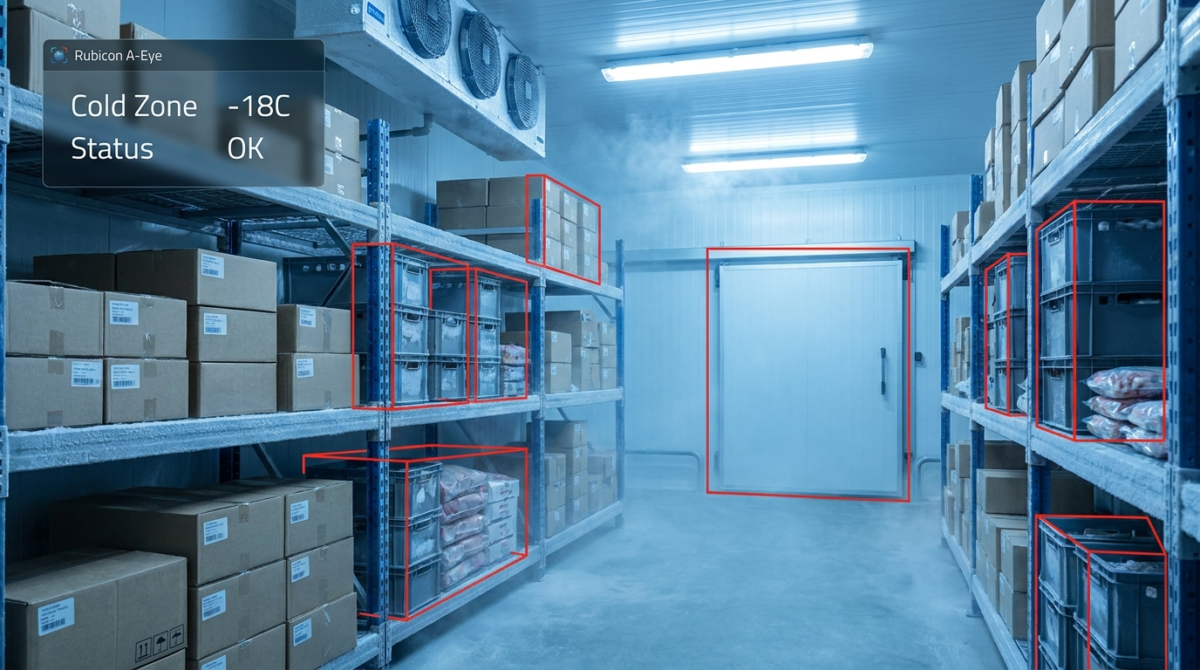
Temperature sensors tell you a chiller is at the right reading. They do not tell you what is actually stocked inside it, how full each rack is, or whether a pallet has been sitting untouched in the wrong corner of the cold room. Rubicon A-Eye adds that visual layer — continuous occupancy and stock-presence visibility inside your cold rooms and chillers, using the cameras you already have, working alongside your existing temperature monitoring rather than replacing it.
The business challenge
Cold storage is one of the most expensive and least visible parts of an F&B distribution facility. Temperature is well instrumented — sensors and loggers tell you whether the chiller or freezer is holding its set point. What almost no facility has visibility into is the stock itself: which racks are full, which are empty, which pallets have not moved in days, and whether someone has left a door open or a position blocked in a space that is expensive to keep cold in the first place.
Because cold rooms are uncomfortable and time-consuming to walk through, they get checked less often than ambient storage, not more. A pallet placed in the wrong bay, a section running empty ahead of a big order, or stock quietly building up in a corner that nobody walks past — all of these go unnoticed for longer in cold storage than anywhere else in the facility, precisely because the environment discourages the manual checks that would normally catch them.
For a cold-chain or warehouse manager, this shows up as a familiar set of pressures:
- No visibility into rack or bay occupancy inside chillers and freezers between manual walk-throughs
- Staff reluctant to spend extra time in cold environments, so checks happen less often than they should
- Stock that has not moved in a chiller for days, discovered only by chance
- Cold-room space that looks full on paper but is poorly utilised in reality, or vice versa
- No way to confirm a door was left open, a position blocked, or stock placed somewhere unexpected, without walking in to look
- Disruptive physical counts in environments where staff want to spend as little time as possible
The hidden cost of an unseen cold room
Cold storage capacity is one of the most expensive square metres in a distribution facility, and an unseen cold room is capacity that may be poorly used without anyone knowing. Stock that sits forgotten in a chiller occupies racking that a faster-moving line needs. A bay that looks occupied on the system but is actually empty wastes planning time when the next inbound load arrives with nowhere obvious to go. None of this shows up as a single dramatic failure — it shows up as a slow loss of usable capacity and a cold room that always seems tighter than it should be.
How Rubicon A-Eye solves the problem
A-Eye adds a visual occupancy layer to cold storage that sits alongside your existing temperature monitoring, not in competition with it. Cameras positioned to view chiller and freezer racking feed an on-site edge device that reads what is in each bay or zone — occupied, empty, partially filled — and tracks when those states change. This is presence and occupancy detection, not temperature measurement: A-Eye tells you what is stored where, your existing sensors keep telling you how cold it is.
Processing happens on a small on-site computer, with footage staying inside the facility — an important detail in a cold room, where streaming continuous video off-site for cloud processing would be both a bandwidth cost and a data-residency concern. Only the occupancy events — a bay that has emptied, a zone that has not changed in longer than expected, an unexpected obstruction — travel onward into your operational systems.
Because checking cold storage in person is something staff naturally try to minimise, A-Eye is particularly valuable here: it lets the facility maintain a continuous view of cold-room occupancy without anyone needing to spend extra time inside the chiller or freezer to get it. Supervisors get the visibility they would otherwise only have by walking the cold room themselves, without the discomfort or the time cost.
Key capabilities
Bay-level occupancy visibility
See which racks and bays inside chillers and freezers are occupied, empty or partially filled, without sending anyone inside to check.
Stationary-stock detection
Flag pallets or positions that have not changed in longer than expected, surfacing forgotten or stranded stock for review.
Unexpected change alerts
Get notified when a bay empties or fills outside expected patterns, prompting a check before it becomes a planning surprise.
Obstruction & access visibility
Identify when a position, aisle or door area appears blocked, supporting safe and efficient cold-room access.
Space-utilisation view
Understand how cold storage capacity is actually being used across racks and zones, not just how it is allocated on paper.
Reduced manual walk-throughs
Maintain occupancy visibility continuously, cutting how often staff need to enter chillers and freezers purely to check stock.
What you can measure
Visual occupancy monitoring turns the cold room from a space you check occasionally into one you can manage continuously:
- Bay and rack occupancy across chillers and freezers, tracked over time
- Stationary-stock alerts and how quickly they are resolved
- Frequency of unplanned manual walk-throughs before and after deployment
- Cold-storage space utilisation by zone
- Obstruction and access alerts raised
- Time between an occupancy change and the team becoming aware of it
Industry applications
Visual cold-storage occupancy monitoring applies anywhere temperature-controlled stock is held at scale. In the UAE and wider GCC it is especially relevant for:
For dairy, frozen and fresh produce distributors, cold storage is usually the tightest and most expensive capacity in the facility, so understanding real occupancy directly affects how much stock can be accepted on a given day. For pharmaceutical and healthcare cold storage, visual confirmation of what is stored where adds an operational layer of assurance alongside regulatory temperature logging. Any operation where staff avoid spending unnecessary time in cold environments benefits from a way to see inside without walking in.
Business benefits
The value of continuous visual occupancy monitoring in cold storage is practical and measurable. Operations that adopt it typically target:
- Better visibility of actual cold-storage occupancy versus system-allocated capacity
- Fewer manual walk-throughs needed purely to check stock presence
- Earlier detection of forgotten or stranded stock before it becomes a write-off
- Improved planning for inbound loads by knowing real available space in advance
- Reduced staff time spent in uncomfortable chilled and frozen environments
- Better use of expensive cold-storage capacity overall
How it works: the operational workflow
The path from a camera frame to a manager taking action is deliberately short, so visual occupancy data becomes an operational event in your systems rather than something only seen on a walk-through.
Example scenarios
Finding stock that had been forgotten
A pallet placed in a rear chiller bay during a busy receiving day has not been touched since. A-Eye flags the position as stationary well beyond the facility’s normal turnover window. The team checks the pallet, confirms it is still within date, and moves it back into active rotation before it becomes a write-off.
Result: stock recovered and sold through instead of discovered expired at the next full count.
Confirming real space before an inbound load
A large chilled delivery is due, and the planner needs to know whether the cold room actually has room for it. A-Eye’s live occupancy view shows two bays recorded as full in the system are actually empty after an earlier dispatch. The load is planned into that space rather than being held back unnecessarily.
Result: inbound load accepted on schedule using space the system did not know was free.
Catching a blocked freezer aisle
An empty pallet and a stack of packaging are left in a freezer aisle after a pick. A-Eye flags the aisle as obstructed. The team clears it the same shift, before it becomes a safety issue or slows the next picker who needs that access.
Result: obstruction cleared within the shift instead of persisting until someone happened to notice.
Reducing unnecessary cold-room visits
Supervisors previously walked the chiller twice a shift purely to check stock levels visually. With A-Eye’s continuous occupancy view available on the dashboard, walk-throughs are reserved for when an alert actually requires a physical check.
Result: meaningfully fewer staff-hours spent inside chilled and frozen environments.
Integration with your systems
Cold storage occupancy data is most useful sitting next to the temperature data you already trust, in the systems your team already works in. Because Rubicon is a certified Odoo partner as well as an AI engineering team, we treat this integration as core to the solution.
| System | How A-Eye connects |
|---|---|
| Existing temperature monitoring / sensors | A-Eye runs alongside your sensor network, adding occupancy and presence visibility without replacing temperature compliance monitoring. |
| Odoo ERP / Inventory | Occupancy and stationary-stock events update zone context and can prompt stock-movement or investigation tasks. |
| Warehouse management (WMS) | Visual bay states complement transaction records, helping reconcile what the system expects against what is physically there. |
| Dashboards | Live cold-storage occupancy presented to supervisors alongside existing temperature dashboards. |
Frequently asked questions
Does A-Eye measure temperature?
What does it actually detect inside the cold room?
Can cameras work reliably in chillers and freezers?
Do we need to install new cameras inside cold storage?
Does this replace our temperature compliance monitoring?
How does it reduce time spent in cold storage?
Can it detect blocked aisles or doors?
Where is the video processed and stored?
Will it work with our existing Odoo setup?
How long does implementation take?
Does this pair with inventory or goods receiving monitoring?
What does it cost?
See visual cold-storage occupancy monitoring on your facility
Book a demo or a no-obligation site assessment and we will show A-Eye running against your chillers, freezers and your Odoo — alongside the temperature monitoring you already trust.