

Food & Beverage Distribution AI
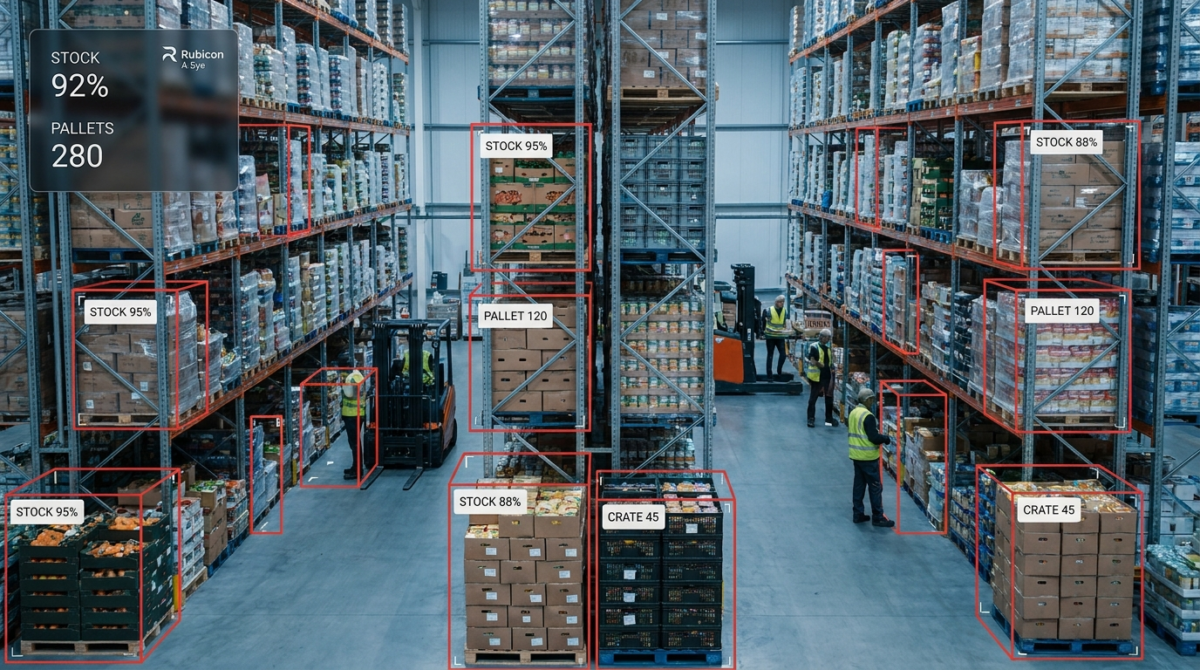
In food and beverage distribution, stock that goes unseen does not sit quietly — it expires, gets pushed out of rotation, or runs out at the worst possible moment. Rubicon A-Eye watches your storage zones continuously through the cameras you already have, giving you a live picture of stock levels and rotation order so FEFO discipline holds and your Odoo records stay matched to what is actually on the shelf.
The business challenge
Perishable inventory is unforgiving in a way dry-goods inventory is not. A pallet of ambient-stable hardware that sits unscanned for a week is an accuracy problem. A pallet of dairy, fresh produce or short-shelf-life beverage that sits unscanned for a week is a write-off waiting to happen. In most F&B distribution operations, the system knows what was received and what was picked, but it does not know which lot is at the front of the shelf, which pallet has been quietly skipped during rotation, or which zone is running down faster than the data suggests.
The root cause is the same gap that affects any warehouse — conventional systems only know what was scanned — but in food and beverage the consequences compound faster. A put-away that places a new lot in front of an older one breaks first-expired-first-out (FEFO) rotation invisibly. A pick from the back of a chilled rack instead of the front goes unrecorded. A slow-moving SKU that should have triggered a markdown two weeks ago is still sitting in full view of nobody, because nobody walks that aisle until the count.
For an F&B distribution manager, this shows up as a recognisable set of daily pressures:
- Stock rotation that depends on staff remembering to check dates, not on a system that enforces it
- Short-dated stock discovered only when it is already too close to expiry to sell through
- Stockouts of fast-moving fresh lines discovered when a route is already loaded short
- Overstock of slower lines tying up chiller and ambient space while it ages toward write-off
- Full counts that are disruptive to run in chilled and frozen areas and still miss rotation errors
- Purchasing and replenishment decisions made on inventory data that lags the physical shelf by days
The hidden cost of inventory you cannot see
In F&B distribution, the cost of inventory blindness is not abstract — it shows up as shrinkage and waste on the P&L. Every pallet that sits past its optimal sell-by window because nobody knew it was there is lost margin. Every fast mover that runs out because the system lagged reality is a missed order, a disappointed customer and, in food, often a lost listing. Add the labour cost of frequent counts in chilled environments, the management time spent reconciling rotation disputes, and the write-off line that quietly grows every month, and the true cost of poor inventory visibility in perishables is materially higher than in dry-goods distribution.
How Rubicon A-Eye solves the problem
A-Eye treats inventory monitoring in an F&B facility as a continuous visibility problem, not a periodic counting exercise. Cameras with a view of your chilled, frozen and ambient storage zones feed an on-site edge device that reads what is in each location — how full it is, whether stock has moved, and when a zone’s level changes. Instead of a snapshot on count day, you get a live, always-current view of where stock sits across the facility, refreshed continuously rather than weekly.
Processing happens on a small computer inside your facility, not in the cloud. Footage never leaves the site, which keeps you aligned with UAE data-privacy expectations and avoids the cost of streaming continuous video off-premise — a meaningful saving when cameras are covering chillers and freezers around the clock. Only the output — zone levels, change events, low-stock conditions — travels onward, straight into the systems your team already uses.
A-Eye does not replace your WMS, barcode scanning or batch/lot tracking; it complements them with the physical ground-truth that scan-based systems cannot provide on their own. Where the live view and the system disagree — a zone that should be empty but is not, a location that emptied faster than expected — you get an early signal to investigate, well before the next count would surface it. Combined with your existing lot and expiry data in Odoo, this turns inventory monitoring into an early-warning system for both stockouts and the slow-moving stock that quietly ages toward write-off.
Key capabilities
Live zone-level visibility
See fill state for every monitored chilled, frozen and ambient location in real time, without walking the aisles or pausing other work.
Low-stock detection
Get notified the moment a fast-moving location drops below a defined threshold, so replenishment happens before the shelf runs empty.
Slow-mover visibility
Surface zones holding stock that has not moved in longer than expected, flagging candidates for markdown or rotation before they age out.
Rotation-order signals
Identify when newer stock appears in front of older stock in a zone, flagging a likely FEFO rotation break for the team to correct.
Discrepancy signals
Surface mismatches between the physical view and Odoo stock records as they happen, enabling same-day investigation instead of a count-day surprise.
Continuous count support
Reduce reliance on disruptive full stock-takes, especially in chilled and frozen zones, by maintaining a live view that lightweight cycle checks can confirm.
What you can measure
Continuous monitoring turns perishable inventory from a periodic audit into a set of live metrics a manager can act on every shift:
- Inventory accuracy maintained continuously, with discrepancy rates trending over time
- Stockout incidents on fast-moving SKUs, by zone and time of day
- Low-stock alerts raised and average replenishment response time
- Slow-moving stock flagged before it reaches a critical age window
- Zone occupancy and chiller/freezer/ambient space utilisation
- Counting labour hours saved against the previous full-count process
Industry applications
Inventory monitoring built for shelf-life awareness applies anywhere perishable or date-sensitive stock moves at volume. In the UAE and wider GCC it is especially relevant for:
For dairy, fresh produce and bakery distributors, shelf life is measured in days, so the lag between a count and reality has an outsized effect on waste. For frozen and longer-shelf-life beverage lines, the priority shifts toward avoiding stockouts on high-velocity SKUs while still catching the occasional pallet that ages past its window in a quiet corner of the freezer. Operations with high SKU counts, mixed shelf lives, and tight delivery windows see the fastest return, because for them the gap between system and shelf is both larger and more expensive.
Business benefits
The value of continuous, shelf-life-aware inventory monitoring is practical and measurable. F&B distributors adopting it typically target:
- Higher inventory accuracy maintained continuously, not just confirmed after counts
- Less spoilage and fewer write-offs through earlier visibility of slow-moving and ageing stock
- Fewer stockouts of fast-moving fresh and chilled lines
- Reduced labour spent on full counts in chilled and frozen environments
- Earlier detection of rotation breaks before they become customer-facing date issues
- Better purchasing and replenishment decisions built on current stock data
- Improved use of chiller, freezer and ambient space
How it works: the operational workflow
The path from a camera frame to a manager taking action is deliberately short, so what A-Eye sees becomes an operational event in your systems — not just a chart nobody checks.
Example scenarios
Catching a fast-mover stockout before it hits a route
A high-velocity chilled SKU is drawing down faster than usual ahead of a weekend order spike. A-Eye detects the pick-face location crossing its low threshold mid-shift and raises a replenishment task in Odoo. Stock is moved up from reserve before the morning loading run, so the dispatch is not short.
Result: stockout avoided without anyone manually walking the chiller aisle.
Flagging a slow-mover before it expires
A beverage SKU promoted last month has slowed down, and a pallet has sat untouched in the same zone for longer than the facility’s normal turnover window. A-Eye surfaces the zone as a slow-mover candidate, and the team applies a markdown and prioritises it in the next outbound run.
Result: stock sold through near full value instead of written off at expiry.
Correcting a rotation break
A new delivery is put away in front of an older lot in the same chilled location, breaking FEFO order. A-Eye flags the zone as having a new arrival ahead of existing stock, and the team re-sequences the location the same shift, before a picker pulls the wrong lot.
Result: rotation error corrected in hours rather than surfacing as an expired return.
Shrinking the disruptive cold-room count
Because the live view is trusted, the operation moves from frequent full counts in the freezer to targeted checks of only the zones where A-Eye and the system disagree. The quarterly cold-room count becomes a short verification exercise instead of a half-day shutdown of the freezer.
Result: counting labour and cold-room downtime both cut substantially.
Integration with your systems
Inventory monitoring delivers its value when its output flows into the systems your team already works in. Because Rubicon is a certified Odoo partner as well as an AI engineering team, integration with ERP and traceability systems is treated as core to the solution, not an afterthought.
| System | How A-Eye connects |
|---|---|
| Odoo ERP / Inventory | Level changes and low-stock events update stock context and raise replenishment or transfer tasks automatically. |
| Lot & batch / traceability systems | Physical zone activity complements lot and expiry records, helping flag rotation breaks against known batch data. |
| Warehouse management (WMS) | Physical zone states complement scan-based transactions, surfacing discrepancies for same-day reconciliation. |
| Dashboards | Live inventory and slow-mover views presented to supervisors and category managers in real time. |
Frequently asked questions
Do we need to install new cameras?
Can A-Eye tell which lot or batch is in front?
Does it work in chilled and frozen storage?
Does this replace our WMS or batch tracking?
How does it help with waste reduction specifically?
Where is the video processed and stored?
How quickly are low-stock conditions detected?
Will it work with our existing Odoo setup?
How long does implementation take?
Can we keep our current counting process running alongside it?
What happens if a camera goes offline?
What does it cost?
See real-time, shelf-life-aware inventory monitoring on your facility
Book a demo or a no-obligation site assessment and we will show A-Eye running against your chilled, frozen and ambient zones, and your Odoo.