

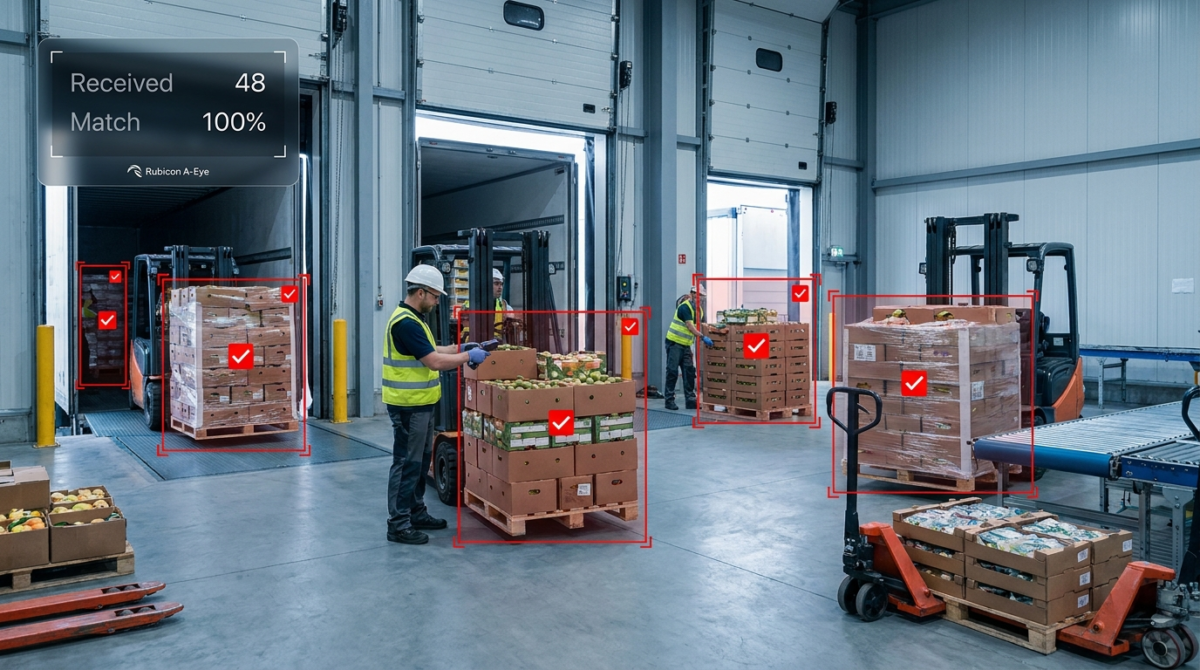
Food & Beverage Distribution AI
Every inventory error has to start somewhere, and a surprising number of them start at the receiving dock — a short delivery accepted without a full count, a damaged case waved through under time pressure, a quantity keyed in from memory rather than verified. Rubicon A-Eye verifies inbound deliveries against the purchase order at the point of receiving, using the cameras you already have at your dock.
The business challenge
Goods receiving is the first point at which your inventory record either matches reality or starts drifting from it. Under time pressure — a truck waiting to be unloaded, a driver wanting a signature, a dock with three deliveries queued behind the current one — a full physical count against the purchase order often gets compressed into a quick visual estimate, and the quantity that gets keyed into the system is whatever was expected rather than what was actually counted.
For food and beverage distribution this matters more than in dry goods, because a receiving error compounds with shelf life. A shortfall not caught at the dock becomes a shortfall discovered only when a picker reaches an empty location days later. Damaged or compromised stock accepted without a proper check becomes a quality issue discovered downstream, sometimes after it has already been mixed into rotation with good stock.
For a receiving or warehouse manager, this shows up as a familiar set of pressures:
- Deliveries accepted against the expected quantity rather than a verified count
- Short deliveries discovered only once the supplier invoice is reconciled, well after the truck has left
- Damaged or visibly compromised stock accepted under time pressure at a busy dock
- No clear visual record to dispute a supplier discrepancy after the fact
- Receiving errors traced back to a specific dock, shift or supplier only through guesswork
- Pressure to turn trucks around quickly, increasing the chance an unverified receipt slips through
The hidden cost of unverified receiving
A receiving error costs more than the value of the missing or damaged stock. It costs the supplier dispute and the management time to chase it, the inventory inaccuracy that follows the error downstream until a count exposes it, and in food and beverage specifically, the risk of compromised stock entering rotation alongside good stock before anyone notices. By the time any of this surfaces, the truck that delivered the shortfall is long gone and the chance to resolve it cleanly with the supplier has often passed.
How Rubicon A-Eye solves the problem
A-Eye treats goods receiving as a verification checkpoint rather than a quick visual estimate. Cameras at the receiving dock feed an on-site edge device that observes what is being unloaded from each truck — tracking pallets, cases or units moving through the dock during a receiving window and building a count of what was actually delivered.
That count can be compared against the expected purchase order, so a discrepancy — fewer units than ordered, an item missing entirely, a mismatch against what the supplier invoiced — is flagged while the truck and driver are still at the dock, while it is still possible to resolve cleanly with the supplier on the spot. Instead of a quantity keyed in from a quick glance, receiving gets an objective, time-stamped count to check the delivery note against.
Processing runs on an on-site edge device, with footage staying inside the facility rather than streaming to the cloud, supporting UAE data-privacy expectations and avoiding ongoing bandwidth cost. A-Eye does not replace your goods-in paperwork or quality checks; it gives the receiving team a verified count to work from, and gives a manager a visual record to resolve a supplier dispute days later without relying on memory.
Key capabilities
Receiving verification at the dock
Track what is unloaded from each truck during a receiving window and compare it against the purchase order.
Short-delivery detection
Flag when fewer units or cases arrive than the purchase order calls for, while the truck is still at the dock.
Mismatch alerts
Surface discrepancies between what was delivered and what was ordered or invoiced by the supplier.
Receiving time tracking
Record how long a delivery takes to unload and verify, supporting dock turnaround and scheduling.
Visual receiving record
Maintain a time-stamped record of each delivery for resolving supplier disputes after the fact, without relying on memory.
Dock utilisation visibility
See how receiving docks are used across a shift, helping identify bottlenecks during peak delivery periods.
What you can measure
Receiving verification turns the dock from an unverified handoff into a measured checkpoint:
- Delivery accuracy against purchase order, tracked by dock, shift and supplier
- Short-delivery and mismatch incidents caught at the dock versus discovered later
- Average receiving and verification time per delivery
- Receiving dock utilisation across the shift
- Supplier disputes resolved using the visual receiving record
- Discrepancies linked back to a specific supplier over time
Industry applications
Inbound delivery verification applies wherever stock is received against a purchase order and accuracy at the point of entry matters. In the UAE and wider GCC it is especially relevant for:
For distributors receiving from a large number of suppliers, verifying deliveries at the dock is the most direct way to hold suppliers accountable for what they actually deliver versus what they invoice. For perishable goods specifically, catching a shortfall or quality issue at receiving avoids it compounding into a downstream stockout or, worse, compromised stock entering rotation. Operations with high inbound volume, multiple suppliers, or frequent invoice disputes see the fastest return from verifying receiving at the source.
Business benefits
The value of goods receiving verification is practical and measurable. F&B distributors adopting it typically target:
- Fewer unverified short deliveries entering inventory records
- Faster resolution of supplier disputes using a verified visual record
- Earlier detection of damaged or compromised stock before it enters rotation
- Better dock turnaround and scheduling using real receiving-time data
- Clearer accountability for discrepancies by supplier, dock and shift
- More accurate inventory records starting from the first point of entry
How it works: the operational workflow
The path from a camera frame to a manager taking action is deliberately short, so a discrepancy is caught at the dock, while the truck is still there to resolve it.
Example scenarios
Catching a short delivery while the truck is still there
A purchase order calls for twenty cases of a chilled line, but only eighteen are unloaded at the dock. A-Eye flags the receipt as short against the PO while the driver is still present. The discrepancy is noted on the delivery note and resolved directly with the supplier on the spot.
Result: shortfall resolved at the dock instead of surfacing as a stockout days later.
Resolving a supplier dispute without guesswork
A supplier invoices for a full delivery that the receiving team believes arrived short. The visual receiving record confirms the actual count unloaded that day, and the invoice is corrected accordingly.
Result: dispute resolved with evidence in minutes, protecting margin on the order.
Flagging a mismatched delivery
A driver delivers a different pack size than what was ordered, easy to miss in a quick glance at a busy dock. A-Eye flags a mismatch between the delivered units and the purchase order’s expected configuration, and the team confirms with the supplier before accepting it into stock.
Result: incorrect stock caught before it is put away and mixed with the correct product.
Identifying a slow dock
Receiving managers notice one dock consistently takes longer to turn around trucks than the others. The receiving-time data confirms that dock’s average is meaningfully longer, pointing to a staffing gap during a particular shift. The team adjusts the schedule and turnaround improves.
Result: faster, more consistent truck turnaround across all receiving docks.
Integration with your systems
Receiving verification is most useful when it speaks directly to the purchasing and inventory systems your team already runs. Because Rubicon is a certified Odoo partner as well as an AI engineering team, this integration is treated as core to the solution, not an afterthought.
| System | How A-Eye connects |
|---|---|
| Odoo ERP / Purchasing | Receiving counts are checked against the purchase order, flagging short or mismatched deliveries for the buyer and receiving team. |
| Warehouse management (WMS) | Visual receiving counts complement goods-in transactions, adding a verified check before stock is put away. |
| Supplier / vendor records | Discrepancy history is attributable to specific suppliers, supporting vendor performance review over time. |
| Dashboards | Live receiving status and historical delivery records presented to supervisors for same-day action and dispute resolution. |
Frequently asked questions
Do we need to install new cameras at the receiving dock?
Does it check the delivery against our actual purchase order?
Can it detect damaged goods?
Does this replace our goods-in paperwork or quality checks?
How quickly is a short delivery flagged?
Can it help resolve supplier invoice disputes?
Where is the video processed and stored?
Will it work with our existing Odoo setup?
How long does implementation take?
Can it monitor multiple docks at once?
Does it work for both pallet and case-level receiving?
What does it cost?
See inbound delivery verification on your receiving dock
Book a demo or a no-obligation site assessment and we will show A-Eye verifying deliveries against your purchase orders, while the truck is still at the dock.