

Logistics AI
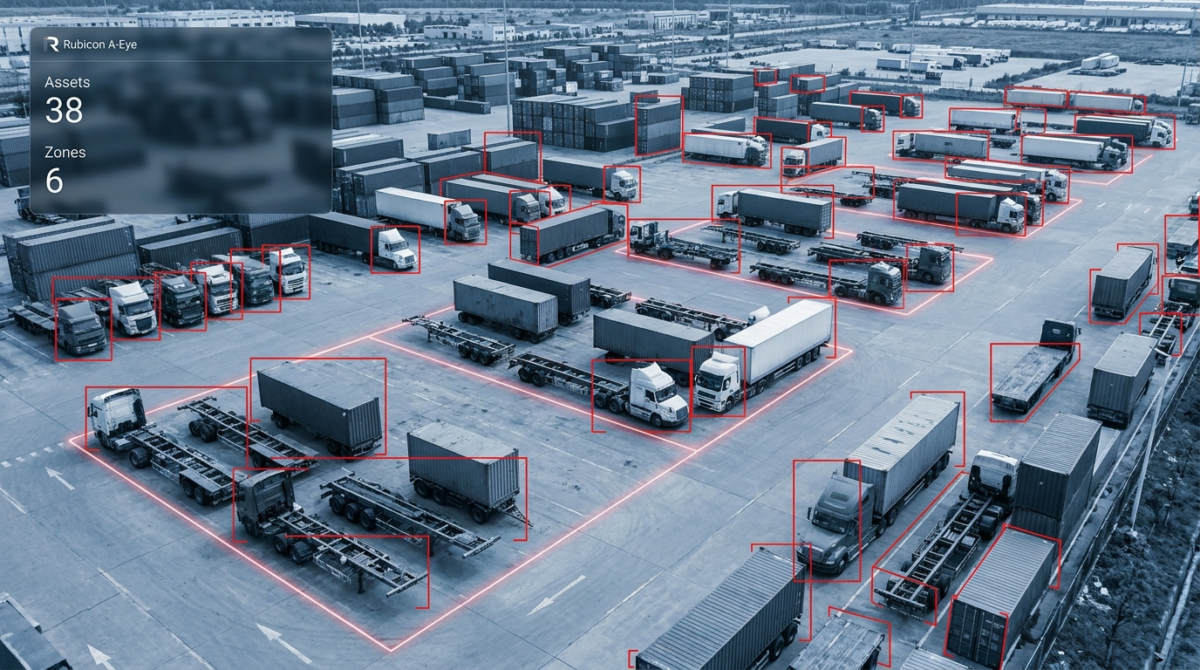
The yard is often the least visible part of a logistics site, yet it is where trailers, vehicles and assets actually sit waiting. Rubicon A-Eye maps positioning across the whole yard continuously, so teams know what is parked where without walking the lot to find out.
The business challenge
A yard full of trailers and vehicles looks orderly from a distance, but ask any yard team where a specific trailer is right now and the honest answer is often “we’ll have to go look.” Positioning inside the yard is rarely tracked with any precision once a vehicle parks — it is remembered, guessed, or rediscovered by walking rows until it turns up. Multiply that across a yard with dozens of trailers and the time spent simply locating things becomes a real operational drag.
The deeper problem is that the yard is spatial in a way that other parts of the operation are not. A dock door or a storage rack has a fixed location that a system can track easily. A trailer can be parked in any of dozens of slots, moved between them without anyone logging it, and left in place for hours or days while nobody updates a record. Without a continuous spatial view, congestion builds in some areas while other areas sit empty, and nobody can say with confidence how long any given trailer has actually been there.
For yard supervisors, the recurring problems look like this:
- Time lost searching for specific trailers or vehicles across the yard
- No reliable record of which slot a trailer is actually parked in
- Congestion building in some areas while other yard space sits unused
- Trailers sitting unnoticed long enough to accrue detention charges
- Difficulty planning incoming arrivals when current occupancy is unclear
- Disputes over how long a trailer has been on site or where it was left
The hidden cost of an untracked yard
Every minute spent searching for a trailer is time a driver or yard worker is not spending on productive work, and it happens repeatedly across a day with dozens of vehicles in play. Trailers that go unnoticed for too long accumulate detention or demurrage costs that could have been avoided with earlier visibility. Uneven use of yard space pushes congestion into specific areas, slowing every vehicle trying to move through them. None of this shows up as a single dramatic failure, but cumulatively it is a steady drag on yard efficiency that a spatial view can remove.
How Rubicon A-Eye solves the problem
A-Eye treats the yard as a space to be mapped continuously, not a lot to be checked occasionally. Cameras covering yard zones and parking rows feed an on-site edge device that identifies where vehicles and trailers are positioned, when they move, and how long they have remained in a given slot or area. Instead of relying on memory or a walk-through, you get a live spatial picture of the entire yard.
Processing runs on a small computer inside your facility, not in the cloud. Footage never leaves the site, which keeps you aligned with UAE data-privacy expectations and avoids the bandwidth cost of streaming video off-premise. The output — positions, slot occupancy, dwell time, congestion patterns — is what travels onward, straight into the systems your yard team already uses.
This is distinct from dock-specific monitoring and from vehicle-arrival detection at the gate: yard management is about spatial positioning across the whole lot once a vehicle is inside it — which slot it occupies, how long it has stayed there, and whether traffic through the yard is flowing or congesting. Used this way, the yard stops being the part of the operation nobody can see and becomes a space that is actively managed.
Key capabilities
Live yard positioning map
See where every monitored trailer and vehicle currently sits across the yard, without sending anyone to check.
Slot and parking assignment tracking
Know which slots are occupied, which are free, and whether vehicles are parked where they were assigned.
Dwell-time and detention visibility
Track how long a trailer has sat in the yard, flagging it before detention charges accumulate unnoticed.
Congestion detection
Identify yard areas and routes that are becoming congested before they fully block movement.
Search-time elimination
Locate a specific trailer or vehicle instantly from the live map instead of walking rows to find it.
Yard-wide occupancy view
Understand total yard utilisation at a glance, supporting better planning of incoming arrivals.
What you can measure
Continuous yard mapping turns positioning from a guess into operational data a yard supervisor can act on every shift:
- Slot occupancy and free-space availability across the yard in real time
- Dwell time per trailer or vehicle, flagged against detention thresholds
- Search time eliminated compared to manual walk-throughs
- Congestion frequency and location across yard zones and routes
- Yard-wide utilisation trends across shifts, days and peak periods
- Positioning accuracy compared to assigned slots or expected locations
Industry applications
Yard management applies wherever vehicles and trailers occupy a shared yard space that needs active spatial management. In the UAE and wider GCC it is especially relevant for:
For 3PLs and freight forwarders managing trailers on behalf of clients, dwell-time visibility directly protects against avoidable detention costs. For terminals and large industrial yards, a live spatial map replaces the walk-through that otherwise consumes meaningful staff time across a shift. For sites where yard space is genuinely constrained, congestion detection helps identify where flow is breaking down before it stalls incoming or outgoing traffic entirely.
Business benefits
The value of continuous yard mapping is practical and immediate. Operations that adopt it typically gain:
- Less time spent searching for specific trailers or vehicles
- Earlier visibility into trailers approaching detention thresholds
- Better-balanced use of yard space, reducing localised congestion
- Improved planning of incoming arrivals based on real occupancy
- A clearer record of vehicle positioning to resolve disputes
- Reduced reliance on manual walk-throughs to confirm yard status
- Smoother overall traffic flow through the yard during peak periods
How it works: the operational workflow
The path from a camera frame to a yard team taking action is deliberately short. A-Eye is built so that what it observes about positioning becomes a usable operational event, not just a map nobody checks.
Example scenarios
Finding a trailer without walking the yard
A dispatcher needs a specific trailer urgently but has no record of exactly where it was parked two shifts ago. The live yard map shows its current slot immediately, and a driver is sent directly to it instead of searching row by row.
Result: trailer located in seconds instead of a walk-through search.
Catching a trailer before detention hits
A trailer has been sitting in a far corner of the yard longer than its allowed free time, but no one flagged it because it was out of the way. A-Eye’s dwell-time tracking surfaces the threshold breach, and the yard team moves it for dispatch before detention charges accumulate further.
Result: avoidable detention cost caught before it grew.
Easing congestion before it blocks a route
Vehicles parking informally near a main yard route gradually narrow the path until traffic starts backing up. A-Eye flags the congestion pattern as it builds rather than after vehicles are already stuck. The yard team redirects parking before the route fully blocks.
Result: congestion addressed early instead of after a backup forms.
Planning arrivals around real occupancy
A yard manager is deciding whether to accept several additional incoming trailers for the day. The live occupancy view shows exactly how much yard space is genuinely free right now, rather than an estimate based on this morning’s count.
Result: arrival planning based on current occupancy instead of a stale estimate.
Integration with your systems
Yard management data delivers its value when it reaches the systems your dispatch and yard teams already use. As a certified Odoo partner and AI engineering team, Rubicon treats this integration as core to the solution rather than an afterthought.
| System | How A-Eye connects |
|---|---|
| Odoo ERP / Logistics & Dispatch | Positioning and dwell-time data updates yard status and trailer records automatically. |
| Transport management (TMS) | Slot occupancy and dwell alerts support trailer scheduling and detention management. |
| Dashboards | Live yard map and dwell alerts presented to yard supervisors and dispatch teams. |
| Reporting systems | Occupancy, dwell-time and congestion data exported for operational and client reporting. |
Spatial mapping and positioning technology
Yard management uses a similar visual-detection approach to other A-Eye capabilities but adapted for spatial positioning rather than zone transitions. The system divides the yard into logical slots or rows based on your physical layout, then continuously monitors which slots are occupied and by what. The definition of a slot is operational, not physical: a “slot” might be a specific parking space marked on the ground, or it might be a zone within a storage row. This is configured during setup to match your yard-management process.
Detection works by analysing the live camera feed against the defined slot boundaries. When a trailer is in a slot, the system recognises it and tracks how long it has been there. If you define threshold times for detention or free-parking windows, the system automatically flags trailers approaching those limits. The output is a live occupancy map: a top-down view showing which slots are full and which are empty, updated continuously.
Accuracy depends on camera coverage and angle. Ideally, each yard section has at least one overhead or high-angle camera that can see most or all of the parking slots in that section. During the site assessment, the team maps coverage and specifies any additional cameras needed to eliminate blind spots. In large yards, this might involve multiple cameras per area, but because the system processes locally on edge hardware, adding more cameras is a matter of configuration rather than new infrastructure.
Congestion detection and traffic flow analysis
Beyond simple occupancy, yard management systems can detect traffic patterns and congestion. By monitoring movement through defined yard corridors or routes, the system recognises when vehicles are moving slowly, backing up, or being re-routed due to congestion. This allows proactive management: if a main route through the yard is becoming congested, a supervisor can reroute incoming traffic or reassign parking to other areas before the route fully blocks.
Congestion detection is configurable: you can set sensitivity thresholds so the system flags emerging problems without drowning supervisors in minor traffic delays. For yards handling high vehicle volumes, this early warning can be the difference between a busy shift and one where traffic movement actually stops.
Detention management and dwell-time compliance
A critical application for large facilities and 3PLs is detention management. In many operations, carriers are entitled to free parking for a set number of hours (typically 24-48 hours depending on the agreement), and detention charges accrue thereafter. Without continuous dwell tracking, trailers can exceed their free time window without anyone noticing until the charges appear in the carrier’s invoice, leading to disputes.
A-Eye yard management solves this by automatically flagging when a trailer approaches and then exceeds the free-parking threshold. A supervisor gets an alert with the trailer’s position and arrival time, and can take action: is the trailer waiting for goods to be loaded or unloaded, in which case it can be prioritised? Is it waiting for a carrier to collect, in which case the carrier can be chased? Or is it genuinely stuck, in which case it can be moved to free up a slot? The point is that the decision is made consciously, not discovered later in a dispute.
Integration with dispatch and asset-management systems
Yard positioning data is most useful when connected to your dispatch, TMS and asset-management systems. In Odoo, trailer records can be updated automatically with current position and dwell time, so a dispatcher always knows not just that a trailer is “in the yard” but exactly where and how long it has been there. For 3PLs managing client trailers, this integration means you can provide clients with real-time positioning without manual lookups.
Some operations also integrate yard positioning with automated gate/yard-access systems, so a trailer’s position is tracked from arrival through parking to pickup, creating a complete audit trail. While this level of integration is optional, it is an increasingly important capability for major carriers and 3PLs managing high volumes.
Frequently asked questions
How is this different from dock utilisation or vehicle detection?
Does it work for large yards?
Can it track both trailers and other vehicle types?
Do we need to install new cameras?
Where is footage processed and stored?
How is dwell time calculated for detention purposes?
Will it integrate with our existing Odoo or TMS setup?
How long does implementation take?
Does it assign parking slots automatically?
Can it detect congestion before it becomes a problem?
Does this replace manual yard checks entirely?
What does it cost?
See your yard mapped in real time
Book a demo or a no-obligation site assessment and we will show A-Eye mapping positioning against your yard and your Odoo.