

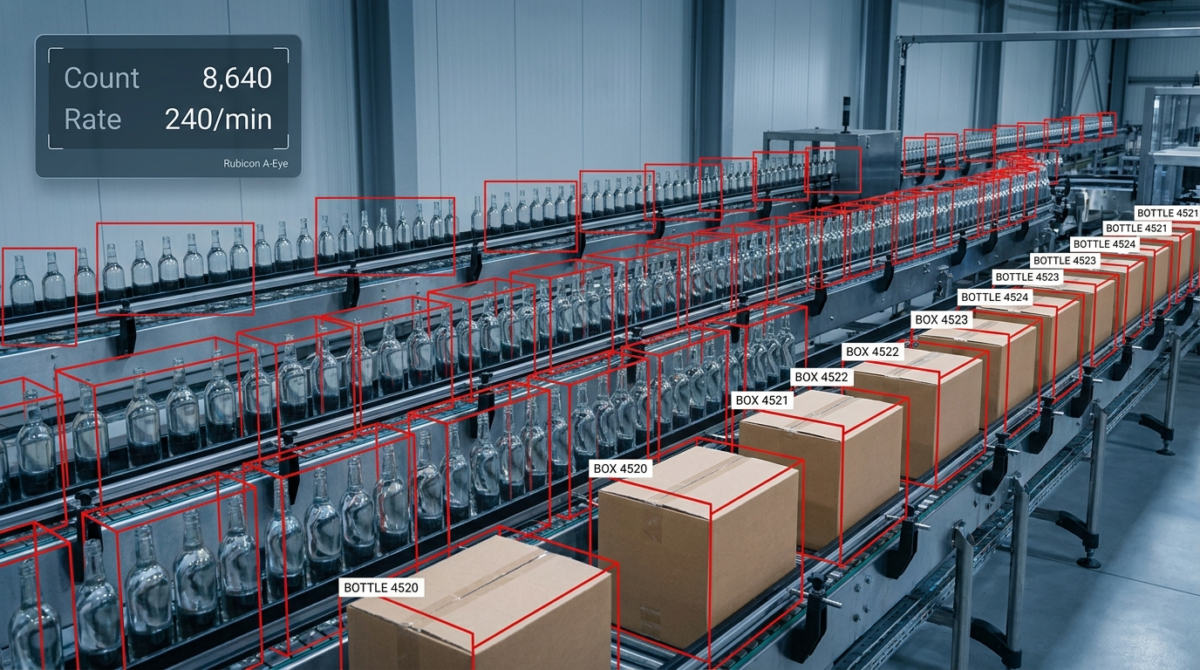
Automated vision-based unit counting for assembly lines and packaging stations—eliminating manual batch verification, reducing recount errors, and enabling real-time output validation without line slowdown or invasive hardware.
The Counting Challenge
Your Current Reality
- Manual counting at end-of-shift requires line stops (15–30 min) or parallel labor; discrepancies discovered too late.
- Batch counts of 100–500 units verified by eye; recount errors occur in 3–8% of batches, necessitating reconciliation or rework.
- Mechanical counters age and drift; digital counters rely on operator button presses prone to missed units.
- No visibility into where counting errors originate: assembly line, packing station, or shipping miscount.
- Hidden cost: 2–4 labor hours per shift spent on recounts; customer claims for missing units create warranty risk.
How Product Counting Solves It
A-Eye’s Product Counting uses frame-by-frame vision to track individual parts as they move through assembly or packaging:
- Individual Part Recognition: Detects and tracks each discrete unit, even in high-speed or bulk flows, with sub-millisecond timing accuracy.
- Continuous Batch Validation: Real-time count vs. target; alerts issued if shortfall emerges before batch completion.
- Recount-Free Verification: Camera-verified count becomes the source of truth, eliminating manual verification and disputes.
Key Capabilities
High-Speed Unit Detection
Counts individual units on lines up to 600 parts/min, even in overlapping or stacked scenarios, without require mechanical counters or operator input.
Batch Target Enforcement
Operator sets batch size; A-Eye automatically alerts when count reaches 95%, 100%, or custom threshold—enabling just-in-time hand-offs.
Defective Unit Tagging
Optional: If integrated with defect detection, marks which units failed QA and excludes them from batch count, maintaining accuracy.
Duplicate Prevention
Tracks unit position and motion; prevents double-counting if a part hesitates or reverses direction mid-line.
Multi-SKU Support
Distinguishes different product geometries by learned feature sets; single camera monitors mixed-product lines with category-specific batch rules.
Instant Handoff Signals
Sends count completion signal via API/Modbus to automation: triggers conveyor advance, bin swap, or label printer without operator intervention.
What You Can Measure
Industry Applications
Business Benefits
Operational Workflow
Example Scenarios
Scenario 1: Real-Time Shortfall Detection
Situation: Packaging line targets 250 units per batch. At 240 units counted, line stoppage occurs (jammed carton). Operator doesn’t notice immediately.
Without A-Eye: Batch runs to completion at 240 units. Discovered at recount station 30 min later. Batch flagged for rework; shipment delayed.
With A-Eye: Dashboard alerts operator at 240 units: “Shortfall: 10 units. Batch incomplete.” Operator pauses, investigates jam, resumes. Final count: 250. Result: Shortfall caught in real time; rework avoided.
Scenario 2: Eliminate Manual Recounts
Situation: Electronics assembly line produces 500 units/shift. Current process: manual count at line end + recount at packing. Average recount discrepancy: 3–4 units.
Without A-Eye: Labor: 1 operator × 6 recounts/shift × 15 min/recount = 90 min/day. Discrepancy disputes require supervisor review.
With A-Eye: Automated count at line exit point; batch certified with image proof. Operator confirms visual once (2 min). Zero recounts needed. Result: 88 min labor saved/day; 99.7% accuracy with proof.
Scenario 3: Multi-SKU Production
Situation: Beverage capping line produces 3 bottle sizes: Small (500 ml), Medium (750 ml), Large (1 L). Batch targets vary: 480 small, 360 medium, 240 large per shift segment.
Without A-Eye: Manual counts by SKU; operator must swap counters or use separate lines. Errors in SKU transitions.
With A-Eye: Single camera learns 3 geometries. Automatically classifies each bottle; increments separate counters. Alerts when each SKU batch hits target. Result: Multi-SKU batching managed automatically; no operator switching overhead.
Scenario 4: Pharma Compliance
Situation: Pharmaceutical blister pack line must maintain lot traceability and count verification for FDA audits. Current: manual count + audit trail on paper forms (3–5 sec discrepancies per batch).
With A-Eye: Automated count logged with timestamp, image, lot number, operator ID. Data feeds compliance database; audit report auto-generates. Result: Tamper-proof count record; audit-ready data in seconds.
Integration & Data Flow
| System | Integration Method | Data Shared |
|---|---|---|
| ERP / WMS | REST API or CSV export | Batch ID, count, timestamp, SKU, lot number |
| Conveyor / Automation | Modbus / API command | Batch complete signal → trigger advance or bin swap |
| Label Printer | TCP socket or REST | Batch count & lot info for carton labels |
| QA / Compliance DB | Direct write (A-Eye logs) | Frame-level unit detections, batch proof image |
| Mobile App | WebSocket (live updates) | Current batch count, % complete, alerts |
Frequently Asked Questions
How fast can A-Eye count?
A-Eye processes 30 FPS by default, reliably counting units at rates up to 600 units/min on standard conveyors. For faster lines, use dual cameras or increase frame rate to 60 FPS (contact us for high-speed benchmarking).
What if units overlap or stack?
A-Eye uses motion tracking to separate overlapping units. Even if units touch, their individual trajectories are resolved frame-by-frame. Extreme stacking (3+ units deep) may require dual-angle cameras for 100% accuracy; we can model this for your specific geometry.
Can A-Eye count transparent items (glass bottles, clear plastic)?
Yes. A-Eye uses structured light or edge detection to identify transparent units. For optimal results, we recommend a LED ring light positioned to create rim/shadow definition. We’ve validated counting on glass, PET, HDPE, and acrylic.
How long is the training/calibration process?
A-Eye learns unit geometry in 50–100 sample frames (~3–5 sec of live production). For multi-SKU setups, allow 2 min per SKU. No special reference objects needed; pure vision-based geometry recognition.
What’s the accuracy rate in real-world conditions?
99.7% accuracy on standard conveyor counts (validated via sampling). Causes of missed units: extreme blur (conveyor >2 m/sec) or severe lighting transients. All missed/extra units are flagged in batch report.
Can I integrate the count signal with my existing conveyor system?
Yes. A-Eye provides REST API, Modbus TCP, or generic webhook outputs. When batch reaches target, we can send a pulse (GPIO), HTTP POST, or Modbus register write to trigger downstream automation (bin advance, label print, gate open, etc.).
How is batch proof maintained for traceability?
A-Eye stores a single snapshot of the completed batch (taken at count completion) along with metadata: batch ID, count, timestamp, operator, line ID, lot/SKU. All stored with encryption; retention is configurable (7–365 days).
What happens if lighting changes mid-shift?
A-Eye includes adaptive lighting compensation. If brightness shifts >15%, the system re-calibrates its detection thresholds in real time, maintaining accuracy without operator intervention.
Can A-Eye count items in bins or trays, not just conveyors?
Yes, for stationary counting. Position camera above a bin/tray and set a region of interest. A-Eye counts unique units in the ROI. For hand-loading scenarios, accuracy depends on regular spacing; cluster-packed items may have 2–3% error due to occlusion.
How much will Product Counting cost?
A-Eye Pro tier includes Product Counting ($12,500/year for 1–5 lines). Enterprise tier offers unlimited lines + custom integrations from $40,000/year. Setup and API integration included. Request a custom quote for your facility.
Is on-premise storage available for sensitive batches?
Yes. A-Eye offers edge/on-premise deployment: all counting and data storage happens on local GPU. Cloud connectivity is optional (sync-on-demand). Ideal for pharmaceutical, defense, or highly regulated environments.