

Food & Beverage Distribution AI
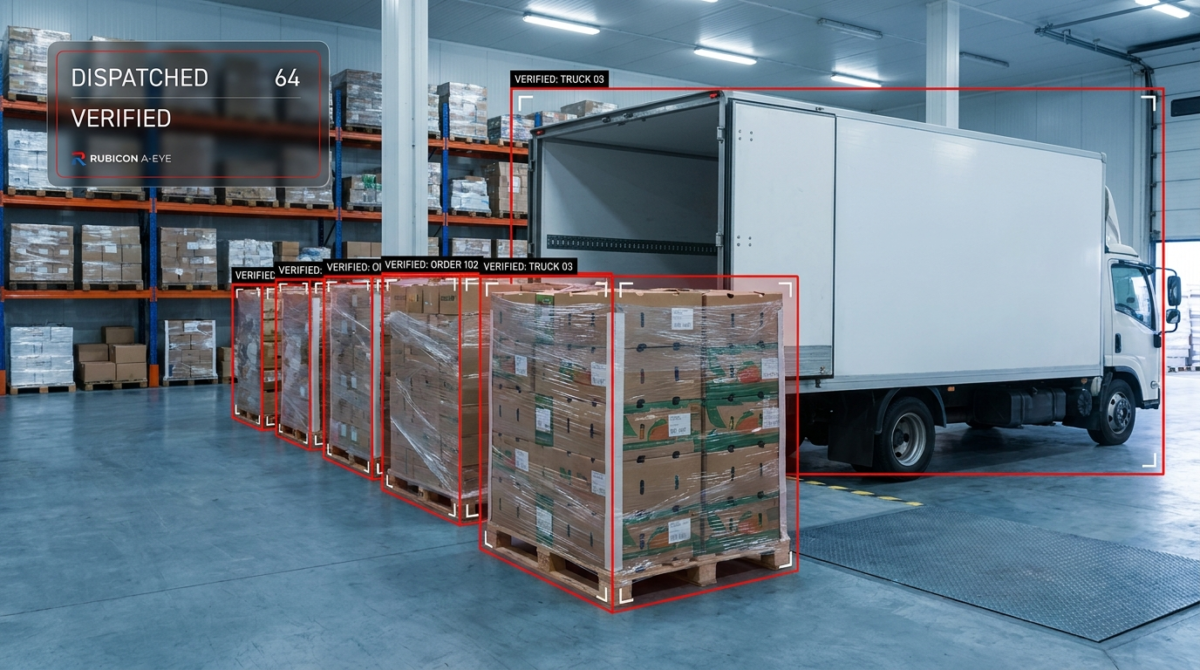
The most expensive mistakes in F&B distribution happen at the loading bay, in the minutes before a truck pulls away — a short load, a wrong SKU, a missed order line that nobody catches until a customer calls. Rubicon A-Eye verifies outbound loads against the order before the truck leaves, using the cameras you already have at your dispatch doors.
The business challenge
Dispatch is the last checkpoint before stock leaves your control, and in most distribution operations it is also the least verified step in the entire order cycle. Pickers and loaders work fast against tight delivery windows, and the final check that what is on the truck matches what was ordered often comes down to a driver’s visual glance or a paper checklist ticked from memory rather than from a confirmed count.
Once a truck leaves the yard, any discrepancy becomes someone else’s problem to solve in the field — a route driver short on a delivery, a customer receiving the wrong case count, a return trip that costs more than the margin on the order. In food and beverage specifically, a short or wrong load is also a customer relationship problem: HORECA and retail customers running on tight stock themselves do not have slack to absorb a distributor’s loading error.
For a dispatch or operations manager, this shows up as a familiar set of pressures:
- Loads verified by a quick visual check rather than a confirmed count against the order
- Short or wrong loads discovered only when a customer calls to query a delivery
- No record of what was actually loaded if a dispute arises after the truck has left
- Loading errors traced back to a specific bay or shift only through guesswork
- Pressure to load fast against delivery windows, increasing the chance of an unverified load slipping through
- Repeat trips and credit notes eating into margin on orders that should have been right the first time
The hidden cost of an unverified load
A short or incorrect load rarely costs just the value of the missing items. It costs a return trip, a credit note, a customer service call, and often a dent in the customer’s confidence in your reliability — which in F&B distribution, where many customers have ready alternative suppliers, is the cost that compounds. Add the management time spent investigating each dispute and the difficulty of identifying exactly where in the process the error occurred, and the true cost of unverified dispatch is consistently higher than it appears from the credit notes alone.
How Rubicon A-Eye solves the problem
A-Eye treats dispatch as a verification checkpoint rather than a visual glance. Cameras at the loading bay feed an on-site edge device that observes what is being loaded onto each truck — tracking pallets, cases or units moving through the bay during a loading window and building a record of what went onto a given vehicle.
That record can be compared against the expected order or manifest, so a discrepancy — fewer units loaded than expected, an item missing entirely, a mismatch against the planned load — is flagged before the truck leaves the yard, while it is still cheap and fast to correct. Instead of relying on a loader’s memory or a rushed paper tick-list, dispatch gets an objective, time-stamped account of what physically went out the door on each load.
Processing runs on an on-site edge device, with footage staying inside the facility rather than streaming to the cloud, which keeps the system aligned with UAE data-privacy expectations and avoids ongoing bandwidth cost. A-Eye does not replace your dispatch documentation or driver checklists; it gives them a verified visual record to confirm against, and gives a manager a way to resolve a delivery dispute days later without relying on memory.
Key capabilities
Load verification at the bay
Track what is loaded onto each truck during a dispatch window and compare it against the expected order.
Short-load detection
Flag when fewer units or cases are loaded than the order calls for, before the truck pulls away.
Wrong-load alerts
Surface mismatches between what was loaded and what was planned for a given vehicle or route.
Dispatch time tracking
Record how long a vehicle spends loading at the bay, supporting on-time departure against delivery windows.
Visual dispatch record
Maintain a time-stamped record of each load for resolving customer disputes after the fact, without relying on memory.
Bay utilisation visibility
See how dispatch bays are used across a shift, helping identify bottlenecks during peak loading periods.
What you can measure
Dispatch verification turns the loading bay from an unverified handoff into a measured checkpoint:
- Load accuracy against order, tracked by bay, shift and route
- Short-load and wrong-load incidents caught before departure versus after
- Average loading time per vehicle against delivery-window targets
- Dispatch bay utilisation across the shift
- Customer disputes resolved using the visual dispatch record
- Repeat-trip and credit-note incidents linked back to loading errors
Industry applications
Outbound load verification applies wherever orders are picked, loaded and dispatched against a delivery commitment. In the UAE and wider GCC it is especially relevant for:
For multi-drop route delivery, where a single short load can affect several customers down the route before anyone notices, catching the error at the bay has an outsized benefit. For HORECA and retail supply, where customers often run lean on their own stock, an accurate first-time load protects a relationship that an alternative supplier would happily take. Operations with tight delivery windows, high order-line counts, or frequent customer disputes see the fastest return from verifying loads at the source.
Business benefits
The value of dispatch verification is practical and measurable. F&B distributors adopting it typically target:
- Fewer short or wrong loads reaching customers
- Faster resolution of delivery disputes using a verified visual record
- Reduced repeat trips and credit notes caused by loading errors
- Better on-time departure performance against delivery windows
- Clearer accountability for loading errors by bay and shift
- Improved customer confidence in delivery accuracy
How it works: the operational workflow
The path from a camera frame to a manager taking action is deliberately short, so a discrepancy is caught at the dock, not at the customer’s door.
Example scenarios
Catching a short load before departure
An order for twelve cases of a chilled line is picked, but only ten reach the truck during a busy loading window. A-Eye flags the load as short against the manifest before the driver pulls out. The remaining two cases are located and loaded within minutes.
Result: complete delivery reaches the customer with no return trip required.
Resolving a delivery dispute without guesswork
A customer disputes a delivery three days later, claiming a case was missing. The dispatch team checks the visual load record for that route and confirms the full order was loaded and signed for on departure. The dispute is resolved with evidence instead of a default credit note.
Result: dispute closed in minutes using a verified record, protecting margin on the order.
Spotting a wrong-route load
During a hectic multi-route morning, an order intended for Route B is mistakenly staged and loaded onto the Route A truck. A-Eye flags a mismatch between the loaded pallets and Route A’s expected manifest. The error is caught at the bay and corrected before either route departs.
Result: both routes depart with the correct loads, avoiding a missed delivery on Route B.
Identifying a bottleneck bay
Dispatch managers notice deliveries from one bay consistently run later than others. The load-time data shows that bay’s average loading time is meaningfully longer than the rest, pointing to a staffing or layout issue rather than random variation. The team rebalances staff and the gap closes.
Result: more consistent on-time departure across all dispatch bays.
Integration with your systems
Dispatch verification is most useful when it speaks directly to the order and delivery systems your team already runs. Because Rubicon is a certified Odoo partner as well as an AI engineering team, this integration is treated as core to the solution, not an afterthought.
| System | How A-Eye connects |
|---|---|
| Odoo ERP / Sales & Delivery | Load verification events are checked against the sales order or delivery manifest, flagging short or mismatched loads. |
| Warehouse management (WMS) | Visual load counts complement pick-and-pack confirmations, adding a final check at the point of departure. |
| Route / delivery planning systems | Dispatch timing data supports on-time departure tracking against planned delivery windows. |
| Dashboards | Live dispatch status and historical load records presented to supervisors for same-day action and dispute resolution. |
Frequently asked questions
Do we need to install new cameras at the loading bay?
Does it check the load against the actual order?
Can it tell the difference between similar-looking products?
Does this replace our driver checklist or paperwork?
How quickly is a short load flagged?
Can it help resolve customer delivery disputes?
Where is the video processed and stored?
Will it work with our existing Odoo setup?
How long does implementation take?
Can it monitor multiple bays at once?
Does it work for both pallet and case-level loading?
What does it cost?
See outbound load verification on your dispatch bays
Book a demo or a no-obligation site assessment and we will show A-Eye verifying loads against your orders, before the truck leaves.