
Retail AI
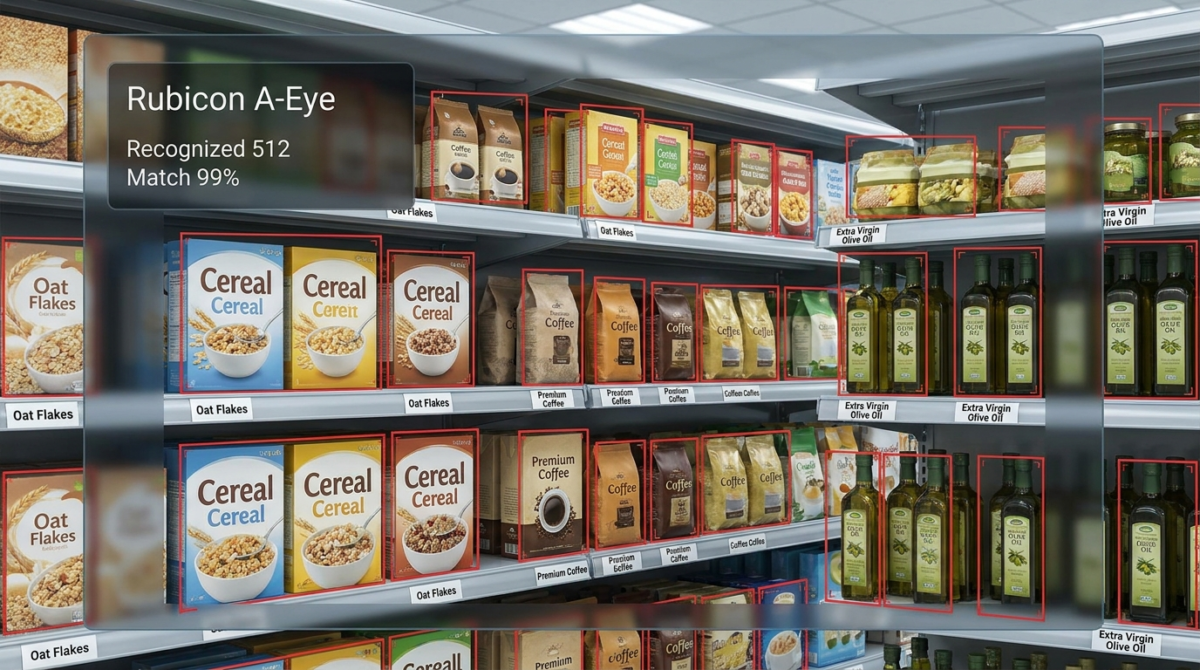
Knowing a shelf has a gap is useful. Knowing exactly which SKU is missing, misplaced or sitting in the wrong facing is what actually drives precise restocking. Rubicon A-Eye identifies products and their placement on shelf, turning generic shelf monitoring into line-level accuracy for availability, planogram compliance and misplacement detection.
The business challenge
Generic shelf monitoring answers one question well: is there a gap. It cannot answer the next, more useful question: which product is missing, and is everything else on that shelf where it is supposed to be. Without product-level identification, a retailer can know a shelf section looks wrong without knowing whether it is an out-of-stock, a misplaced item, or a planogram violation — three problems with three different fixes.
Misplacement in particular is a problem that facing-level gap detection cannot see at all. A product sitting in the wrong location is not a gap; the shelf looks full. But the item the customer is looking for is not where the planogram says it should be, the customer cannot find it, and depending on category, may not think to look elsewhere. The shelf appears stocked while quietly failing to deliver the sale.
For category and merchandising teams, this gap between “the shelf looks fine” and “the shelf is actually correct” produces recurring problems:
- Out-of-stocks confirmed only after a customer or staff member manually checks the specific SKU
- Misplaced products that go unnoticed because the shelf still appears full
- Planogram compliance checked rarely, manually, and inconsistently across stores
- Restocking tasks that are vague — “shelf 4 needs attention” instead of “SKU X is out”
- No reliable way to verify that a new planogram rollout was actually executed correctly in every store
- Merchandising and supplier compliance disputes with no objective shelf-level evidence
The hidden cost of generic shelf data
A retailer operating on facing-level gap data alone is solving roughly half the on-shelf execution problem. The other half — correct placement, planogram compliance, line-specific availability — either goes unmeasured or requires the exact kind of manual shelf audit that is slow, infrequent and inconsistent between stores and auditors. Every planogram rollout, supplier slotting agreement and category review depends on knowing what is actually on the shelf at the SKU level, and without product recognition, that knowledge comes from spot checks rather than continuous fact.
How Rubicon A-Eye solves the problem
A-Eye’s product recognition identifies which specific products are present on a monitored shelf and where they sit relative to their defined planogram position. This sits a level deeper than facing-level gap detection: instead of treating the shelf as a generic surface that is either full or empty, the system reads the shelf as a set of specific products in specific places.
The recognised product range is configured during setup — typically prioritising high-velocity, high-value or planogram-critical lines first, and expanding from there. The model is trained against your actual packaging and shelf conditions, so it reliably distinguishes between similar-looking products, private-label variants and packaging refreshes, rather than treating the shelf as an undifferentiated block of stock.
Once products are identified, two distinct capabilities follow. First, availability becomes line-specific: an alert can say exactly which SKU is low or missing, not just which shelf section looks affected. Second, placement becomes verifiable: the system can compare what is actually on the shelf against the planogram and flag products that are present but in the wrong location, missing entirely, or where an unauthorised substitute has appeared. Processing runs on-site, so footage stays in the store and only product-identification and placement events are sent onward to staff, dashboards and Odoo.
Key capabilities
SKU-level identification
Recognise specific products on shelf, not just generic stock presence, across your configured priority range.
Planogram compliance checks
Compare actual shelf placement against the defined planogram and flag deviations as they occur.
Misplacement detection
Identify products sitting in the wrong location even when the shelf appears fully stocked overall.
Line-specific availability
Turn a generic gap alert into a precise “this SKU is out” notification, enabling accurate, targeted restocking.
Variant & packaging distinction
Tuned to tell apart similar packaging, private-label variants and seasonal refreshes within a category.
Rollout verification
Confirm that a new planogram or promotional layout was actually executed correctly, store by store.
What you can measure
- Line-level availability rate for each recognised SKU, by shelf and store
- Planogram compliance rate across monitored shelf sections
- Misplacement incidents detected and time to correction
- Rollout accuracy following a new planogram or promotional layout change
- Restocking precision — tasks resolved against the correct SKU on the first attempt
- Supplier slotting compliance across stores and categories
Industry applications
Product recognition is most valuable wherever SKU-level accuracy and planogram discipline directly affect sales and supplier relationships:
Grocery and pharmacy retailers benefit from precise availability on high-SKU-count categories where a generic “shelf 4” alert is not actionable enough. Beauty and personal-care retail, where planogram and slotting agreements with suppliers are commercially significant, gain objective compliance evidence. Multi-store and franchise networks benefit from a consistent, store-independent way to verify that planogram rollouts were executed as intended everywhere, not just where someone happened to check.
Business benefits
- Restocking tasks that name the specific product, reducing wasted staff trips and guesswork
- Earlier detection of misplacement that generic shelf monitoring cannot see
- Objective, store-wide evidence of planogram compliance instead of occasional manual audits
- Faster, verifiable rollout of new planograms and promotional layouts across a network
- Stronger basis for supplier slotting and compliance conversations
- Higher-quality availability data that supports category and assortment decisions
How it works: the operational workflow
Example scenarios
Turning a generic gap into a precise restock
A shelf section shows reduced stock during a busy afternoon. Where facing-level monitoring alone would only flag “this section is low,” product recognition identifies exactly which two SKUs out of six on that shelf are actually out, letting the restocking team go straight to the backroom for the right items instead of checking the whole range.
Result: a faster, accurately targeted restock instead of a general shelf check.
Catching a misplacement the shelf hid
A high-margin item has been placed in the wrong facing after a rushed restock, while a lower-margin substitute sits in its planogram position. The shelf looks fully stocked to a passing glance, but A-Eye flags the placement mismatch, and staff correct it before the discrepancy affects sales mix for the week.
Result: a misplacement caught and fixed that a full-looking shelf would otherwise have hidden indefinitely.
Verifying a planogram rollout across stores
Head office rolls out a new seasonal planogram to forty stores. Rather than relying on store-by-store self-reporting, the merchandising team uses A-Eye’s compliance data to confirm execution accuracy in each location within days, and flags the handful of stores that need a follow-up visit.
Result: rollout compliance verified at scale instead of assumed.
Supporting a supplier slotting conversation
A supplier disputes whether their agreed shelf position and facing count are being honoured. Objective, time-stamped placement data from A-Eye settles the question with evidence rather than a one-off manual check that may not reflect typical conditions.
Result: a slotting compliance discussion grounded in continuous data, not a snapshot.
Integration with your systems
Product recognition data is most useful when it drives precise action in the systems your team already uses. As a certified Odoo partner and AI engineering team, Rubicon builds this connection directly into the solution.
| System | How A-Eye connects |
|---|---|
| Odoo ERP / Inventory | Line-specific availability and misplacement events generate precise, SKU-level replenishment or correction tasks. |
| Planogram & merchandising tools | Detected shelf layout can be compared against the defined planogram for compliance reporting. |
| Dashboards | SKU-level availability and compliance views by shelf, store and category for merchandising teams. |
| Reporting systems | Compliance, misplacement and availability metrics exported for category and supplier reporting. |
Implementation and rollout
Product recognition is introduced through a deliberately staged rollout, since the recognised product range and planogram rules need to be configured and validated against your actual shelves. A typical project begins with a site assessment to confirm camera coverage and agree the priority product range, followed by model training against your real packaging and shelf conditions. During validation, recognition output is checked against manual shelf audits until accuracy meets your requirement, and planogram rules are confirmed against your actual merchandising standards before compliance alerts go live.
Most retailers start with a focused product range — the highest-velocity, highest-margin, or most planogram-sensitive lines — and expand recognition coverage over subsequent phases rather than attempting to recognise an entire store’s assortment at once. This keeps initial training and validation manageable while delivering value on the categories where SKU-level accuracy matters most, with the range growing as the system proves itself.
Why product-level recognition outperforms manual audits
The conventional way to check planogram compliance and catch misplacement is a manual shelf audit, walked periodically by a merchandiser or store team member. This works, but only as a snapshot: it reflects the shelf at the moment of the audit, depends on the auditor’s thoroughness and consistency, and is too infrequent to catch most misplacement before it has sat uncorrected for days or weeks.
Continuous, camera-based product recognition replaces the snapshot with an ongoing check. Because the system is always reading the shelf, a misplacement or compliance deviation is flagged close to when it happens, not at the next scheduled audit, and the standard applied is identical across every store and every shelf rather than varying with who happened to do the walk. For retailers managing planogram compliance across a multi-store network, this consistency is often more valuable than the speed of detection alone, because it finally makes store-to-store comparison meaningful.
Frequently asked questions
How is this different from shelf monitoring?
How many products can it recognise?
Can it tell apart similar-looking variants or packaging refreshes?
Does it support planogram compliance checking?
Can it detect a product that is misplaced but the shelf looks full?
Is footage processed on-site?
Does this use customer-identifying data or facial recognition?
Can it verify a planogram rollout across many stores?
How does this connect to Odoo?
Does it require shelf monitoring or low stock alerts to be deployed first?
How long does implementation take?
What does it cost?
See your shelf at the product level
Book a demo or a no-obligation site assessment and we will show A-Eye recognising products on a shelf like yours.