

Retail AI
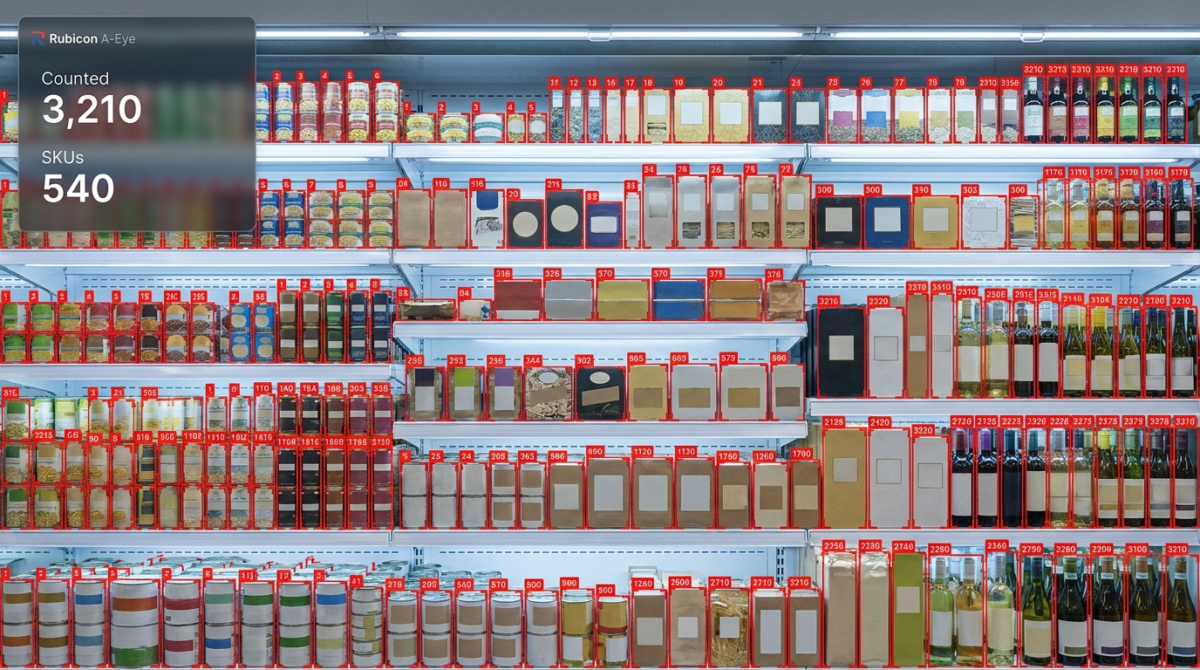
Retail inventory accuracy lives and dies on count frequency, and most stores can only afford to count rarely. Rubicon A-Eye counts stock continuously across shelves and backroom storage using cameras you already have, so the unit count behind every shelf and stockroom location stays close to reality every day, not just on count day.
The business challenge
Retailers run on a number that is almost always slightly wrong: the unit count in their inventory system. Cycle counts and full stock-takes happen periodically — weekly, monthly, or quarterly depending on the category — and between those counts, the real number drifts. Shrinkage, miscounted deliveries, damaged stock that was never logged, and units moved between shelf and backroom without a transaction all open a gap between what the system says and what is actually on the premises.
That gap is expensive in both directions. Overstated counts lead to false confidence — buyers do not reorder because the system says stock exists, and a stockout follows. Understated counts trigger unnecessary reorders, tying up cash and shelf or backroom space in stock that was already there. Either way, the decisions made from the count — what to order, what to discount, what to investigate — are being made from a number nobody fully trusts.
For store operations and inventory teams, this produces a familiar set of frustrations:
- Counts that are disruptive enough to run only occasionally, so accuracy decays between them
- Shelf and backroom totals that frequently disagree with the system, with no clear cause
- Replenishment decisions made on stale or disputed numbers
- Staff time consumed by physical counts instead of customer-facing work
- Shrinkage and loss that is only quantified well after it happened
- No reliable way to know the true count without sending someone to physically check
The hidden cost of infrequent counting
The labour cost of a stock count is visible and budgeted. The cost of the inaccuracy that accumulates between counts is not, and it is usually larger. Every day spent operating on a number that has drifted from reality produces a small ordering error, a small stockout risk, or a small amount of dead stock sitting where it should not be. None of these show up clearly on their own, but compounded across every SKU, every store, every week between counts, they represent a continuous and largely invisible drag on both service levels and working capital.
How Rubicon A-Eye solves the problem
A-Eye turns stock counting from a periodic event into a continuous background process. Cameras with coverage of shelves and backroom storage feed an on-site edge device that estimates unit and case counts in each monitored area, updating as stock is sold, moved, or replenished. Instead of a count that is accurate for one moment a month, you get a count that stays current every day.
This is deliberately broader in scope than shelf-facing gap detection. Where shelf monitoring asks “is this facing empty,” stock counting asks “how many units are actually here” — on the shelf, in the backroom, or both, depending on the camera coverage you put in place. The two work well together: shelf monitoring catches the immediate customer-facing gap, while stock counting maintains the underlying number that drives ordering and reconciliation.
Processing runs entirely on-site. Footage never leaves the store, and only count data — the figures themselves, not video — flows onward to Odoo and your dashboards. The model is tuned during setup to your shelf layout, packaging and backroom storage style, so counts remain reliable across dense shelving, mixed case and unit stock, and varying lighting conditions. Where the physical count and the system record disagree, that gap becomes a visible signal to investigate immediately, rather than a discrepancy discovered weeks later at the next scheduled count.
Key capabilities
Continuous shelf counts
Live unit counts for monitored shelf sections, updated as stock sells and is replenished, without a manual walk.
Backroom counting
Extend the same continuous counting into stockroom and storage areas wherever camera coverage allows.
Reconciliation signals
Surface gaps between the physical count and the Odoo record as they appear, instead of waiting for the next stocktake.
Case and unit handling
Configured to your packaging mix, so mixed case and individual unit stock are both counted reliably.
Shrinkage visibility
Track count trends over time to spot unexplained loss patterns earlier than a quarterly stock-take would.
Reduced manual counting
Lean on a trusted continuous count for day-to-day decisions, reserving manual counts for occasional verification.
What you can measure
- Live unit and case counts by shelf, zone and store
- Discrepancy rate between physical counts and Odoo inventory records
- Count drift over time between manual verification checks
- Counting labour hours eliminated versus the previous process
- Shrinkage trends by category, store and period
- Replenishment accuracy improvements from current versus stale counts
Industry applications
Continuous stock counting applies wherever retail inventory accuracy directly affects ordering, shrinkage control and service:
High-SKU-count grocery and pharmacy operations benefit most directly, since manual counts there are the most disruptive and the drift between them the most costly. Multi-store chains gain a consistent, comparable counting method across every location instead of count quality varying by store team. Fashion and electronics retailers with high-value, lower-turnover stock benefit from earlier shrinkage detection on lines where loss is expensive per unit.
Business benefits
- Inventory accuracy maintained continuously rather than only at count intervals
- Fewer ordering errors caused by stale or disputed stock figures
- Reduced labour spent on disruptive manual counts and re-counts
- Earlier detection of shrinkage and unexplained stock loss
- A factual basis for resolving counting disputes between teams
- Better-informed replenishment and purchasing decisions across the store network
How it works: the operational workflow
Example scenarios
Catching a delivery miscount
A delivery is received and logged into Odoo, but the backroom camera count shows fewer cases than the system recorded. The discrepancy is flagged the same day, and the team traces it to a mis-keyed receiving entry before it distorts ordering for that SKU over the following weeks.
Result: a data-entry error corrected in hours instead of surfacing as a mystery shortage at the next stocktake.
Reducing the quarterly stock-take
Because the continuous count is trusted, a multi-store chain shifts from a full physical stock-take every quarter to a lighter verification pass that only checks the locations where A-Eye and Odoo disagree. The exercise that used to take a full day per store now takes a fraction of that.
Result: counting labour and store downtime cut substantially across the network.
Spotting a shrinkage pattern early
Count trend data shows a specific high-value category consistently losing more units than sales and recorded waste explain, across several stores. The pattern is flagged for loss-prevention review months before it would have been caught by the next scheduled count.
Result: a shrinkage issue identified and investigated while it is still small.
Supporting confident replenishment
A category buyer reviewing reorder suggestions sees that the live A-Eye count for a slow-moving line is meaningfully higher than the Odoo record assumed, after stock was moved from backroom to shelf without a transaction. The reorder is held, avoiding an unnecessary purchase.
Result: capital protected by ordering against the real count, not a stale one.
Integration with your systems
Stock counting delivers its value through the systems your team already runs. As a certified Odoo partner and AI engineering team, Rubicon treats this integration as core, not an add-on.
| System | How A-Eye connects |
|---|---|
| Odoo ERP / Inventory | Continuous counts reconcile against stock records and flag discrepancies for review or automatic adjustment. |
| POS systems | Counted stock can be cross-checked against sales velocity to validate count accuracy over time. |
| Dashboards | Live and trended count views by shelf, zone, store and category for managers and inventory teams. |
| Reporting systems | Discrepancy and shrinkage metrics exported for operational and loss-prevention reporting. |
Implementation and rollout
Continuous counting is introduced gradually so the team can build trust in the numbers before relying on them for ordering decisions. A typical rollout begins with a site assessment to map shelf and backroom camera coverage, followed by configuration tuned to your products and packaging mix. During validation, A-Eye runs alongside your existing count cycle so the live count can be benchmarked directly against known-good manual counts, with tuning continuing until the discrepancy rate meets your accuracy requirement. Only once that confidence is established does the team start reducing manual count frequency and acting on A-Eye’s reconciliation flags directly.
Most retailers begin with shelf-level counting in a defined set of stores or categories, then extend into backroom coverage and additional locations once the approach is proven. Because the system runs on existing cameras and on-site processing, a single-store pilot can typically be live within weeks, with a wider rollout following on a schedule that matches your store estate.
Why continuous counting outperforms periodic stock-takes
The conventional response to inventory drift is to count more often, but more frequent manual counts simply multiply labour cost while still producing a number that is only accurate at the instant it was taken. The gap between counts — however short — is where drift accumulates, and tightening the schedule never eliminates that gap, it only shrinks it at increasing cost.
Camera-based continuous counting removes the gap rather than shrinking it. Because the system is watching constantly, there is no interval during which drift can build unnoticed: a discrepancy between the physical count and the Odoo record becomes visible close to the moment it occurs, not at the next scheduled count weeks later. For multi-store retailers, this also means every location is counted to the same standard continuously, rather than count quality varying with how thoroughly each store team happens to execute its own stock-take.
Frequently asked questions
Does this replace our manual stock-takes entirely?
Can it count both the shelf and the backroom?
How is this different from shelf monitoring?
How accurate are the counts?
Does it work with mixed case and unit stock?
Where is the video processed?
Will it identify exactly which product is short?
Can it help us investigate shrinkage?
Do we need new cameras?
How does it integrate with Odoo?
How long does implementation take?
What does it cost?
Keep your stock count true, every day
Book a demo or a no-obligation site assessment and we will show A-Eye counting stock in a store like yours.