

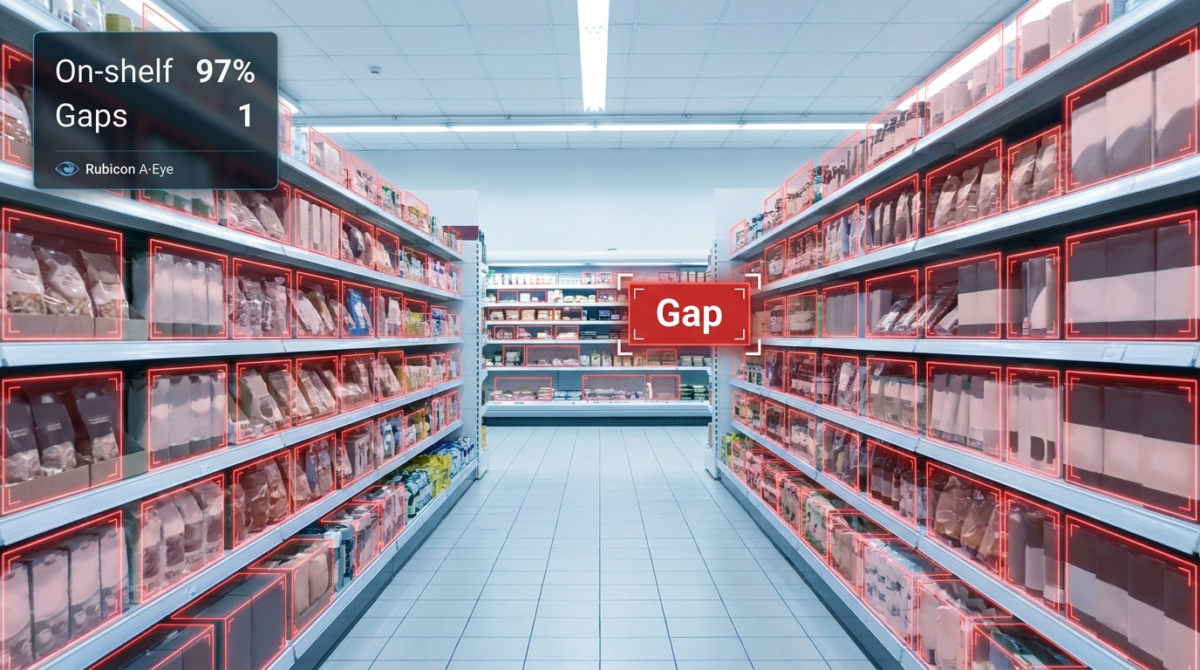
Retail AI
An empty facing is a sale that already happened to someone else. Rubicon A-Eye watches your shelves continuously through the cameras you already have, detecting gaps and low facings on the shelf itself the moment they appear, so staff can restock while the customer is still in the aisle, not after the sale is lost.
The business challenge
On-shelf availability is the single biggest driver of retail sales that nobody actively manages in real time. A product can be sitting in full quantity in the backroom while the shelf facing in front of a customer is completely empty — and from a sales perspective, that stock does not exist. The customer does not walk to the stockroom to check; they either substitute, defer the purchase, or leave for a competitor.
The problem is structural, not a staffing failure. Shelves are walked on a schedule — once or twice a shift, sometimes once a day on quieter lines — and a gap that opens five minutes after the last walk can sit empty for hours before anyone notices. Promotions and weekend peaks make this worse: the products most likely to sell out are exactly the ones a fixed walk schedule is least able to catch in time.
For store and category managers, the same pattern repeats every week:
- Gaps discovered by customers or mystery shoppers, not by staff
- Fast-moving and promoted lines selling out mid-shift with no warning
- Shelf walks that are too infrequent to catch short-lived gaps
- No record of how long a facing sat empty or which shelves are chronic offenders
- Staff time spent walking aisles that turn out to be fully stocked
- Lost sales that never show up as a clean number anywhere in the P&L
The hidden cost of an empty facing
A gap on the shelf is invisible in almost every system a retailer runs. POS data shows what sold, not what could not be sold because it was not there. Inventory systems show stock on hand somewhere in the store, not whether that stock is actually presented to the customer. The result is that on-shelf availability — arguably the most direct lever on daily sales — is managed almost entirely by guesswork and walk frequency, while the actual cost of gaps accumulates quietly across every store, every day, every promotion.
How Rubicon A-Eye solves the problem
A-Eye monitors shelf facings directly, continuously, using cameras with a view of the aisle or shelf edge. The system reads the physical state of each monitored shelf section — full, partially depleted, or empty — and flags the change the moment it happens, rather than waiting for the next scheduled walk to discover it.
This is shelf-facing detection, not backroom inventory. A-Eye is looking at exactly what the customer sees: the front of the shelf, the facing, the gap. That distinction matters because availability problems are won or lost at that exact point, and a system that only tracks units somewhere in the store cannot tell you whether the shelf in aisle 4 is empty right now.
Processing runs on an on-site edge device, so footage stays inside the store and only the detection events — gap opened, facing low, shelf recovered — travel onward to staff devices, dashboards and Odoo. The model is tuned during setup to your shelf layout, lighting and product mix, so it reliably distinguishes a genuinely empty facing from normal stock variation, partial depletion, or temporary occlusion by a customer or trolley.
Where product recognition is also deployed, shelf monitoring becomes line-specific — not just “this shelf has a gap” but “this SKU is out.” Without it, A-Eye still delivers reliable facing-level gap detection across the whole monitored range, which is sufficient for the majority of availability problems retailers face.
Key capabilities
Continuous gap detection
Every monitored facing is watched in real time, so an empty shelf is flagged within minutes, not at the next scheduled walk.
Low-facing warnings
Shelves trending toward empty are flagged before they fully deplete, giving staff a window to act ahead of the stockout.
Shelf-level dwell tracking
See how long a gap has existed, not just that it exists, so chronic problem shelves are visible and prioritised.
Aisle and zone coverage
Monitor whole aisles or specific high-value shelf sections, scaled to the cameras and priorities you choose.
Promotion and peak coverage
Maintain shelf-level visibility precisely when fixed walk schedules are weakest — during promotions, weekends and peak footfall.
Staff task routing
Detected gaps route directly to the nearest available staff member or a prioritised task list, instead of a general announcement.
What you can measure
- Number of gaps detected per shelf, aisle and store, over any period
- Average time a facing sits empty before it is restocked
- Shelves and categories with chronic or repeated gap patterns
- Gap incidence during promotions versus normal trading periods
- Staff response time from alert to shelf restocked
- Estimated availability rate across monitored shelf sections
Industry applications
Shelf-facing monitoring applies anywhere on-shelf availability drives sales and a gap is expensive to miss:
Grocery and supermarket operations see the most direct benefit because fast-moving categories sell out within hours and a missed gap on a promoted line is a visible, repeated loss. Convenience and forecourt stores, often running with thin staffing, gain a way to catch gaps without adding headcount. Pharmacy and health retail benefit from catching gaps on high-turnover essentials where customers rarely wait or substitute.
Business benefits
- Fewer missed sales from gaps that go unnoticed between shelf walks
- Faster recovery from empty facings, particularly during promotions and peaks
- Objective, store-wide visibility into which shelves and categories have chronic availability problems
- Better-directed staff time, focused on shelves that actually need attention
- A factual basis for supplier and category conversations about availability
- Reduced dependence on fixed walk schedules as the only availability check
How it works: the operational workflow
Example scenarios
Catching a mid-promotion sellout
A promoted snack line draws down faster than forecast on a Saturday afternoon. A-Eye flags the facing as empty within minutes of it happening. A floor staff member, alerted on a handheld device, restocks from the promotional display stock at the back of the aisle before the bulk of the afternoon footfall arrives.
Result: the promotion keeps selling instead of sitting empty for the rest of the day.
Surfacing a chronic problem shelf
A weekly review of gap-duration data shows that one chiller shelf in a particular store empties almost every Tuesday afternoon, well before the evening restock. The store manager adjusts the restocking schedule for that shelf specifically, rather than relying on the general aisle walk.
Result: a recurring availability gap fixed at the root cause, not patched once.
Reducing reliance on walk frequency
A convenience store with two staff on shift cannot walk every aisle every hour. A-Eye covers the high-velocity shelves continuously, so staff are only pulled to check a shelf when an actual gap is flagged, freeing their time for customers and the till.
Result: availability maintained without adding headcount.
Quantifying an availability problem for a supplier conversation
A category manager suspects a particular supplier’s delivery pattern is causing recurring gaps on a specific line. Gap-frequency and dwell-time data from A-Eye, broken down by store and day, gives an objective record to bring to the supplier review rather than an impression.
Result: a supplier conversation grounded in evidence instead of anecdote.
Integration with your systems
Shelf monitoring is most valuable when a detected gap becomes a task, not just a notification. Because Rubicon is a certified Odoo partner as well as an AI engineering team, integration is built into the solution from the start.
| System | How A-Eye connects |
|---|---|
| Odoo ERP / Inventory | Gap events can raise replenishment tasks and feed availability context against stock records. |
| POS systems | Shelf gap data can be reviewed alongside sales data to estimate lost-sale exposure on specific lines. |
| Staff devices | Real-time alerts route to handheld devices or in-store displays for immediate action. |
| Dashboards | Store, aisle and shelf-level gap and dwell-time views for managers and category teams. |
Implementation and rollout
Shelf monitoring is designed to prove itself before you depend on it. A typical rollout runs in four stages: a site assessment to confirm camera coverage and identify priority aisles, configuration to tune detection to your shelf layout and lighting, a validation period where A-Eye runs alongside normal shelf walks so the team can compare detected gaps against what staff actually find, and a go-live stage where alerts begin routing directly to staff devices and reduced walk frequency follows once the system is trusted. Because the system uses existing CCTV and on-site processing, this typically takes weeks rather than months from assessment to live alerting.
Retailers usually start with a defined set of priority aisles — high-velocity categories, promotional zones, or sections with a history of availability complaints — rather than attempting full-store coverage immediately. This keeps the validation period focused and lets staff build trust in the alerts on the shelves where missed gaps are most costly, before extending coverage store-wide.
Why shelf-level detection outperforms fixed walk schedules
The alternative to continuous monitoring is simply walking the shelves more often, and most retailers have already tried tightening that schedule as far as labour budgets allow. The problem is structural: any fixed schedule, no matter how frequent, leaves a window between walks where a gap can open and go unnoticed, and the products most likely to sell out fast are exactly the ones most likely to fall into that window. Doubling walk frequency halves the average exposure time but doubles the labour cost, and still leaves a gap.
Continuous camera-based detection removes the trade-off entirely. Because the system is always watching the monitored shelves, exposure time for a gap is measured in minutes rather than the hours between scheduled walks, and it costs no additional staff time to maintain that coverage once it is in place. For retailers running lean floor teams, this is often the only practical way to materially improve on-shelf availability without adding headcount.
Frequently asked questions
Does shelf monitoring track backroom stock as well?
How quickly are gaps detected?
Can it tell us which specific product is missing?
Do we need new cameras?
Will it confuse a customer standing in front of the shelf with an empty facing?
Is this the same as low stock alerts?
Does it use customer-identifying data or facial recognition?
Where is the video processed?
Can it cover an entire store or only specific aisles?
How does this integrate with Odoo?
What happens during a busy period when many gaps appear at once?
How long does implementation take?
Never lose a sale to an empty shelf
Book a demo or a no-obligation site assessment and we will show A-Eye monitoring shelves like yours.