

Logistics AI
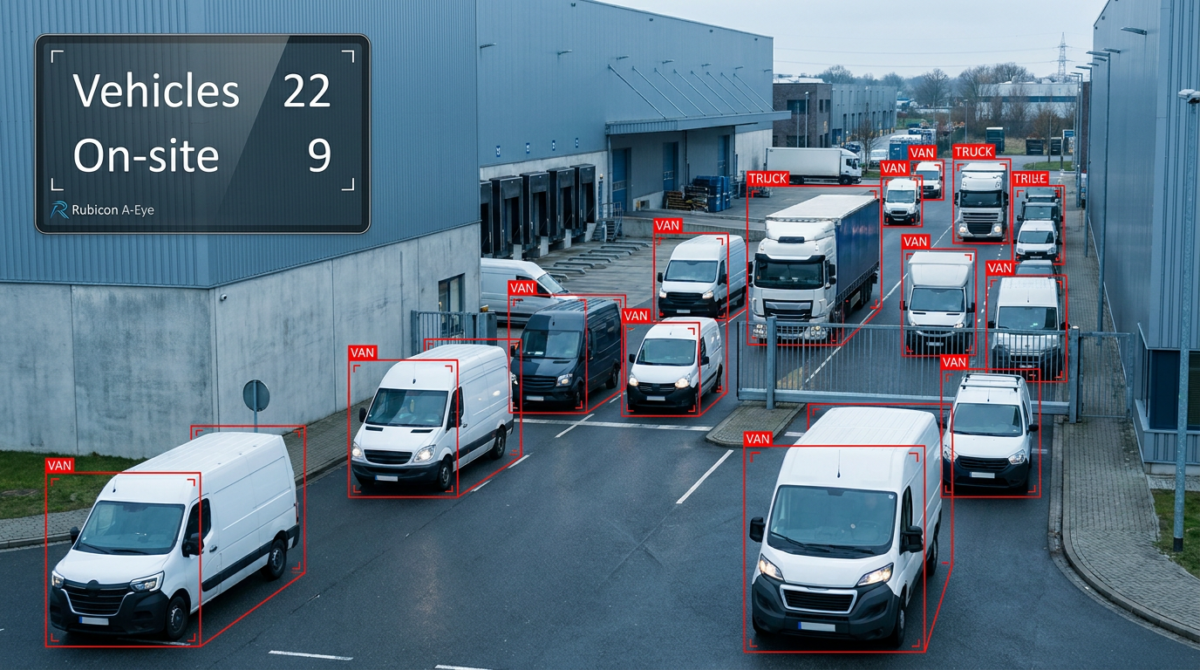
Knowing a vehicle has arrived should not depend on a guard noticing it at the gate. Rubicon A-Eye detects vehicle arrivals, classifies vehicle type and tracks zone occupancy automatically through the cameras already covering your gates and yard.
The business challenge
Most gate and arrival processes still depend on a person noticing a vehicle, logging it manually, and radioing or messaging the relevant team. That chain works most of the time, but it is slow by design and fails quietly: a gate guard distracted by another task, a radio call missed during a shift change, a log entry made minutes after the vehicle actually arrived. None of these failures are dramatic on their own, but together they mean dock and yard teams are routinely reacting to vehicles that have already been waiting rather than preparing for vehicles that are about to arrive.
The deeper issue is that arrival awareness is treated as a manual administrative task rather than an operational signal. By the time a paper log or a verbal handover reaches the team that needs to act, the vehicle has already been sitting, and the window to prepare a dock, stage outbound goods, or schedule a driver has already started shrinking.
For yard supervisors and gate teams, the recurring problems look like this:
- Vehicles waiting at the gate longer than necessary because no one was notified promptly
- Manual gate logs that are incomplete, delayed or inconsistent between shifts
- No reliable record of vehicle volume or arrival timing across the day
- Dock and yard teams reacting to arrivals instead of preparing ahead of them
- Disputes over arrival times when detention or turnaround charges are involved
- Difficulty distinguishing vehicle types quickly enough to route them correctly
The hidden cost of manual gate awareness
Every minute between a vehicle physically arriving and the right team being notified is a minute of turnaround time lost, multiplied across every vehicle that crosses the gate in a day. Detention and demurrage disputes are harder to resolve without a reliable, timestamped arrival record. And because manual logs vary in completeness, the data needed to plan staffing around actual arrival patterns is rarely good enough to plan with confidently. The cost is not one large failure but a steady accumulation of small delays and gaps that add up across a facility’s entire vehicle volume.
How Rubicon A-Eye solves the problem
A-Eye treats vehicle arrival as a detection event rather than a logging task. Cameras covering gates, entry routes and yard zones feed an on-site edge device that identifies when a vehicle is present, classifies the type of vehicle, and recognises movement between zones. The moment a vehicle is detected, the relevant teams can be notified automatically, without anyone needing to see it first.
Processing runs on a small computer inside your facility, not in the cloud. Footage never leaves the site, which keeps you aligned with UAE data-privacy expectations and avoids the bandwidth cost of streaming video off-premise. A-Eye operates at the vehicle level: detecting presence, vehicle type and zone occupancy. It is not a facial-recognition or personal-identification system, and it is not used to identify drivers as individuals — only the vehicle and its movement through monitored zones.
A-Eye does not replace your gate process; it removes the lag from it. Manual logging and driver check-in can continue exactly as they do today, but the operational notification — a vehicle has arrived, here is its type, here is which zone it is in — now happens automatically and immediately. Over time, this turns gate awareness from something that depends on a person noticing into something the system guarantees by default.
Key capabilities
Automatic arrival detection
Know the moment a vehicle reaches the gate or enters a monitored route, without depending on a manual log entry.
Vehicle type classification
Distinguish between trucks, vans and other vehicle categories relevant to your operation, configured during setup.
Zone occupancy detection
See which monitored zone a vehicle currently occupies, supporting routing and dock or yard preparation.
Automatic activity logging
Generate a consistent, timestamped arrival record without relying on manual entries that vary by shift.
Volume and timing patterns
Understand arrival volume and timing across the day to plan gate and dock staffing more accurately.
Detention-relevant timestamps
Provide a reliable arrival timestamp that supports detention and turnaround discussions with evidence.
What you can measure
Automatic vehicle detection turns gate activity from an informal estimate into measurable operational data:
- Vehicle arrival volume by hour, day and vehicle type
- Time from detected arrival to operational notification reaching the right team
- Time from arrival to dock or yard assignment
- Gate and entry-route congestion patterns across peak periods
- Arrival-record completeness compared to the previous manual log process
- Vehicle type mix across the operation over time
Industry applications
Vehicle detection applies wherever vehicles arrive at a facility and timely awareness of that arrival affects operations. In the UAE and wider GCC it is especially relevant for:
For 3PLs and distribution centres, faster arrival awareness shortens the gap between a truck reaching the gate and a dock being prepared for it. For manufacturing and industrial sites, automatic detection reduces dependence on gate staff during shift changes and off-hours. For terminals and yards handling high vehicle volumes, consistent automatic logging replaces gate paperwork that is otherwise prone to gaps during busy periods.
Business benefits
The value of automatic vehicle detection is practical and immediate. Operations that adopt it typically gain:
- Faster notification to dock and yard teams when a vehicle arrives
- Reduced gate paperwork and fewer inconsistencies between shifts
- A reliable, timestamped record to support detention and turnaround discussions
- Better visibility into vehicle volume and timing for staffing decisions
- Fewer delays caused by missed or late manual notifications
- Improved ability to route vehicles to the correct zone promptly
- Less reliance on gate staff catching every arrival manually
How it works: the operational workflow
The path from a camera frame to a team being notified is deliberately short. A-Eye is built so that detection becomes an immediate operational signal, not a delayed log entry.
Example scenarios
Notifying the dock before the truck arrives
A delivery truck is detected entering the site approach route several minutes before it reaches the dock area. A-Eye raises an arrival event that notifies the dock team immediately. By the time the truck reaches its assigned door, the bay is already prepared.
Result: turnaround starts the moment the vehicle stops, with no waiting on staff to notice it.
Resolving a detention dispute
A carrier disputes a detention charge, claiming their vehicle arrived earlier than the facility’s log shows. The automatic arrival timestamp from A-Eye shows the actual detection time, which differs from the manually logged entry. The dispute is resolved using the system record rather than competing recollections.
Result: detention discussion settled with a timestamped record instead of an argument.
Covering a gate during a shift change
A vehicle arrives during a gate shift handover, a period when manual logging has historically been inconsistent. A-Eye detects the arrival regardless of staffing transition and raises the notification automatically, so the gap in manual coverage does not become a gap in operational awareness.
Result: no missed arrivals during shift changes.
Planning gate staffing from real arrival data
A facility manager reviewing several weeks of arrival data notices a consistent volume spike in the late afternoon that gate staffing does not currently match. Staffing is adjusted to cover the actual pattern rather than an assumed one.
Result: gate staffing aligned with real vehicle volume instead of a guess.
Integration with your systems
Vehicle detection delivers its value when arrival data reaches the systems your dispatch and yard teams already use. As a certified Odoo partner and AI engineering team, Rubicon treats this integration as core to the solution rather than an afterthought.
| System | How A-Eye connects |
|---|---|
| Odoo ERP / Logistics & Dispatch | Arrival and vehicle-type events update dispatch records and trigger downstream tasks automatically. |
| Transport management (TMS) | Detected arrivals feed into load planning and carrier coordination without manual entry. |
| Dashboards | Live arrival feed and vehicle-type breakdown presented to gate, dock and yard supervisors. |
| Reporting systems | Arrival volume, timing and detention-relevant timestamps exported for operational and client reporting. |
Understanding vehicle classification and detection accuracy
Vehicle detection begins with classification: the system must distinguish the types of vehicles relevant to your operation. For most logistics facilities, this means separating trucks (larger vehicles) from vans and smaller commercial vehicles, though the categories can be customized during setup. The detection works by analysing shape, size and movement patterns, not by reading individual features.
In practice, classification accuracy depends on camera angle, resolution and distance. A camera positioned perpendicular to an entry route at 3-4 metres, with adequate lighting, can reliably distinguish truck from van. The same camera at 20 metres or at a sharp angle will be less reliable. This is scoped during the site assessment, and additional cameras are specified if key entry points lack adequate coverage.
The system is designed to degrade gracefully: if classification confidence is low for a specific vehicle, it raises the event but with a confidence flag so a supervisor can prioritise manual confirmation if the system is uncertain. Over time, the on-site edge device learns your facility’s specific lighting, camera angles and vehicle fleet, improving accuracy continuously.
Arrival notification workflows and integration points
Once a vehicle is detected, the operational value depends on how quickly the right team is notified. A-Eye integrates with common notification paths: it can post a message to a team messaging system (Slack, Teams), send an SMS to a gate supervisor, or trigger a webhook that your TMS or dispatch system can act on. Most facilities start with simple Slack or email notification and evolve to deeper integration as the team gets comfortable with the information.
For operations running Odoo with a Transport Management System, the integration can be more sophisticated: the arrival event can trigger a workflow that looks up the expected shipment, confirms the vehicle type matches the booking, and automatically assigns a dock if one is available. This removes the manual confirmation step entirely and shortens the time from arrival to dock assignment from minutes to seconds.
The gate log itself becomes more reliable because the system generates a timestamped record automatically. In facilities where detention and demurrage charges are common, this automatic record is invaluable: it provides an objective, auditable arrival timestamp that cannot be disputed because it is not a manual entry.
Extended capabilities and future enhancements
The core vehicle detection capability is arrival and type classification, but the platform supports extensions. Some facilities want to detect the number of axles or trailer configuration to better understand capacity. Others want to recognise vehicles returning after departure and distinguish repeat arrivals from new ones. These are configuration options rather than new products, implemented once the base system proves stable.
A common evolution is pairing vehicle detection with goods movement tracking: once a truck is detected at the gate, the goods it brought can be automatically linked to that vehicle in the tracking system, creating a full chain-of-custody trail from arrival through dispatch. This is particularly valuable for 3PLs managing client shipments where provenance matters.
Frequently asked questions
Does this identify drivers or use facial recognition?
Can it tell different vehicle types apart?
Can it read number plates?
Do we need to install new cameras?
Does it work at night or in poor weather?
Where is footage processed and stored?
How fast is an arrival detected and notified?
Will it integrate with our existing Odoo or TMS setup?
How long does implementation take?
Can it replace our gate logging process entirely?
Does it work across multiple gates or sites?
What does it cost?
See vehicle detection running on a site like yours
Book a demo or a no-obligation site assessment and we will show A-Eye detecting arrivals against your gates and your Odoo.