
Logistics AI
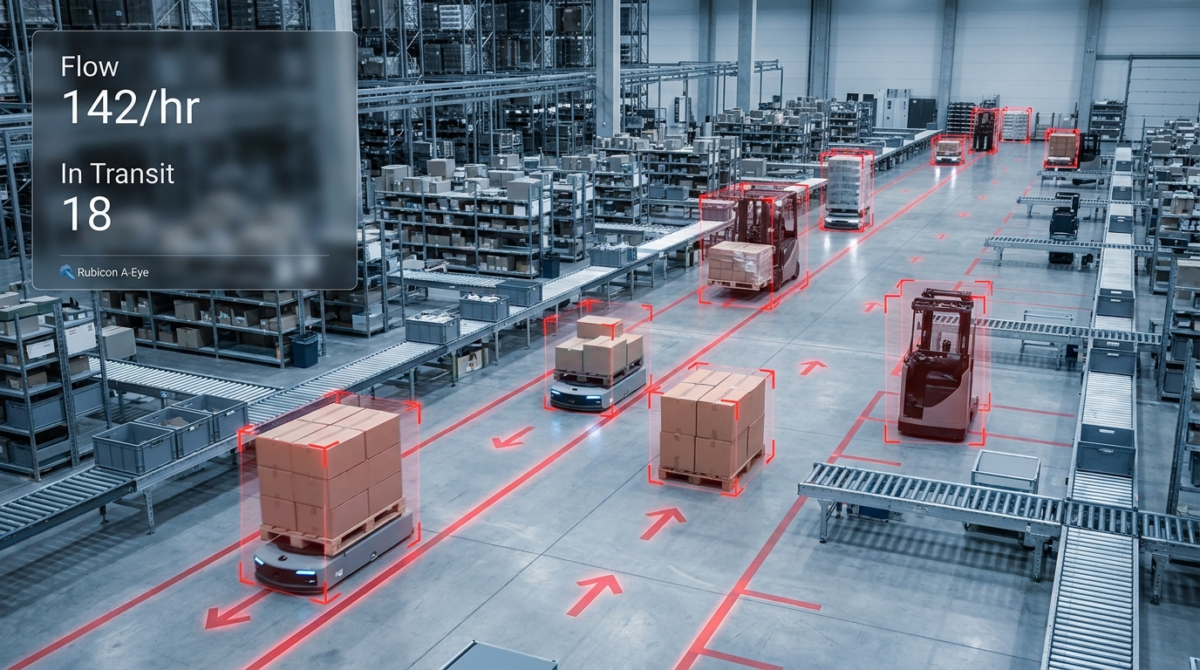
Goods entering a logistics facility cross several handoffs before they leave again — gate, receiving, staging, consolidation, dispatch. Rubicon A-Eye watches the movement of goods across these areas continuously through the cameras already on site, so you always know where shipments are and how long they spent getting there.
The business challenge
In most logistics operations, a shipment’s path through the facility is only visible at the points where someone scans it. Between those scans, goods exist in a gap — moved by a forklift, set down in a staging lane, consolidated with other items, or shifted to make room for something else — and none of that movement is recorded anywhere. The system knows the goods arrived and knows when they left, but the journey in between is invisible.
That gap is where flow problems hide. A pallet staged in the wrong lane sits unnoticed until someone goes looking for it. Goods waiting on a consolidation step stall longer than anyone realises because no one is timing the wait. A shipment that should have moved straight to dispatch instead gets parked behind other freight, and nobody finds out until the truck is already late.
For operations managers and supervisors, the day-to-day symptoms are familiar:
- Shipments that take longer to find than they should, eating into staff time
- No record of how long goods actually sat in staging or consolidation
- Bottlenecks that are only noticed once dispatch is already behind
- Disputes about whether goods were moved, mislabelled or misplaced
- Manual walk-throughs needed just to confirm where freight currently sits
- Little visibility into which handoff in the chain is actually slowing things down
The hidden cost of unseen movement
Every minute a shipment spends untracked is a minute that cannot be explained if a customer asks where their goods are, or accounted for if a manager is trying to find the bottleneck in the flow. Untracked movement also means untracked accountability: when goods go missing or arrive damaged, there is no trail showing which area or which handoff they passed through last. The cost shows up as wasted search time, slower dispatch, unexplained discrepancies, and a flow that managers can describe in general terms but not measure.
How Rubicon A-Eye solves the problem
A-Eye treats goods movement as something to observe continuously, not something to reconstruct after the fact from scan timestamps. Cameras covering receiving, staging, consolidation and dispatch areas feed an on-site edge device that recognises when goods enter an area, move between areas, and how long they remain. Instead of two data points — in and out — you get a continuous trace of the path goods actually took through the facility.
Processing runs on a small computer inside your facility, not in the cloud. Footage never leaves the site, which keeps you aligned with UAE data-privacy expectations and avoids the cost of streaming video off-premise. Only the movement events — zone entries, transfers between areas, dwell durations — travel onward, straight into your operational systems.
A-Eye does not replace your scanning process at receiving and dispatch; it fills the space between those two scan points. Where a shipment dwells longer than expected in a zone, or appears to move through an unexpected path, that becomes a visible, timestamped event rather than something a supervisor has to notice by walking the floor. Over time, this turns the internal journey of goods from an assumption into something you can actually see and measure.
Key capabilities
Zone-to-zone movement tracking
See goods move between receiving, staging, consolidation and dispatch in real time, without anyone walking the floor to confirm location.
Dwell-time visibility
Know how long shipments actually spend in each area, exposing stalls that would otherwise go unnoticed until dispatch is late.
Bottleneck identification
Pinpoint which handoff in the chain is consistently slower than the rest, so improvement effort goes where it matters.
Movement history and accountability
Build a visual record of where goods travelled and when, useful when discrepancies or disputes need to be resolved.
Unexpected-path alerts
Flag goods that follow a route or sequence different from what the operation expects, surfacing errors early.
Facility-wide flow view
See the overall movement pattern across the site, not just one area, to understand how goods actually flow end to end.
What you can measure
Continuous movement tracking turns goods flow from a general impression into a set of metrics a manager can act on every shift:
- Average and outlier dwell time by zone, lane and shipment type
- Time spent at each handoff: receiving, staging, consolidation, dispatch
- Frequency and location of unexpected or delayed movement
- Total transit time from gate arrival to dispatch readiness
- Zone congestion patterns across shifts and peak periods
- Movement-record completeness for accountability and dispute resolution
Industry applications
Goods movement tracking applies wherever shipments pass through multiple handoffs inside a facility before leaving again. In the UAE and wider GCC it is especially relevant for:
For 3PLs and freight forwarders, the ability to show a client exactly how their shipment moved through the facility is a service differentiator as much as an operational tool. In cross-dock operations, where goods are meant to pass through quickly without long storage, dwell-time visibility is the difference between a facility that runs to plan and one that quietly accumulates delay. Cold chain operations gain an additional benefit: time spent outside controlled zones becomes visible and accountable rather than assumed.
Business benefits
The value of continuous goods movement tracking is practical and operational. Facilities that adopt it typically gain:
- Faster identification of where shipments are at any point in the facility
- Earlier detection of bottlenecks before they affect dispatch timing
- A visual record supporting accountability when discrepancies arise
- Less staff time spent walking the floor to locate goods
- Better understanding of which handoffs are consistently slow
- More accurate ERP records of shipment position and status
- Improved ability to explain delays to clients with evidence, not estimates
How it works: the operational workflow
The path from a camera frame to a manager taking action is deliberately short. A-Eye is built so that what it observes becomes a usable operational event, not just a record sitting in a log file.
Example scenarios
Finding a shipment stuck in staging
A pallet destined for an outbound consolidation has been sitting in a staging lane for far longer than the typical handling window. A-Eye flags the dwell-time breach and shows exactly which lane it is in. A supervisor sends a team member directly to the location instead of searching the staging area.
Result: shipment located and moved in minutes rather than discovered late at dispatch.
Spotting the slow handoff
Dispatch has been consistently running behind schedule for several weeks, but the cause is not obvious. The movement history shows that goods routed through one particular consolidation area dwell noticeably longer than goods routed through any other path. Management reassigns staff to that area during peak hours.
Result: the actual bottleneck identified and addressed instead of guessed at.
Resolving a misplacement dispute
A client queries why their shipment was delayed and where it was during the gap. The movement record shows the goods sat briefly in an overflow staging area during a peak period before continuing to dispatch on schedule. The query is answered with a timestamped trail instead of an apology and a guess.
Result: dispute closed with evidence rather than assumption.
Catching an unexpected route
A shipment that should move directly from receiving to consolidation instead appears to pass through an unrelated storage area first. A-Eye flags the unexpected path, and the team discovers a labelling error sent it to the wrong initial location. It is corrected before it reaches dispatch.
Result: a routing error caught mid-flow instead of surfacing as a missed shipment.
Integration with your systems
Goods movement tracking is most useful when its output reaches the systems your team already relies on for dispatch and stock positions. As a certified Odoo partner and AI engineering team, Rubicon treats this integration as core to the solution rather than an add-on.
| System | How A-Eye connects |
|---|---|
| Odoo ERP / Inventory & Logistics | Movement events update shipment position and stage, keeping dispatch records aligned with physical reality. |
| Transport management (TMS) | Dwell and handoff timing feeds into dispatch readiness and load planning. |
| Dashboards | Live flow maps and dwell alerts presented to supervisors and operations managers. |
| Reporting systems | Movement and dwell-time history exported for client reporting and operational review. |
Setting up zone boundaries and movement rules
The practical deployment of goods movement tracking begins with a site walk-through to define the zones your operation cares about. This is not a theoretical exercise: the zones must align with how goods actually flow through the facility, not with how the building is laid out. In a typical cross-dock operation, that means receiving, short-term staging, consolidation (outbound sorting), and dispatch — but the exact layout varies by site.
During the assessment, the team identifies camera coverage that can see transitions between these zones. Most facilities already have CCTV over these areas for security; the question is whether the camera angles, resolution and lighting are adequate for continuous visual detection. If gaps exist, additional cameras are specified in the proposal.
Once zones are defined, the rules are configured on the edge device: how long goods are expected to dwell in each zone before moving, which transitions are normal and which are unexpected, and what constitutes a dwell-time breach worth flagging. These rules can be refined over the first few weeks of operation based on real movement patterns, so the initial configuration does not need to be perfect.
A key decision is whether to track at the level of general flow — “goods moved from receiving to staging” — or individual shipments — “SKU #12345 passed through staging at this time.” Most 3PLs and cross-docks start with general flow because it requires less configuration and immediately solves the visibility problem. Individual shipment tracking can be added later if the operational need becomes clear.
Real-world deployment workflow and data flow
Once deployed, the system runs continuously. The edge device processes camera feeds at the point of capture, recognises zone entries and exits, and logs dwell time. It maintains a local database of recent movement events so a supervisor can query the last hour or day without connecting to external systems. Every few minutes, a summary of movement events is sent to your dashboard and integrated systems (Odoo ERP, reporting databases), so the operational team stays in sync with what is happening on the floor.
From an operational standpoint, the value manifests in two ways. First, in the dashboard itself: a supervisor can see live movement patterns and check on a specific shipment’s last known location and dwell time, often answering questions before they escalate. Second, in the systems your team already uses: if you run Odoo, shipment records can be automatically updated with movement-detected status changes, so the system of record stays aligned with what is physically happening.
During high-volume periods, the system generates event streams rather than real-time queries, so warehouse staff see a prioritised feed of things that matter — a breach threshold, an unexpected path, a shipment stalled in an area — rather than every single movement. This is configurable based on your tolerance for alerts.
Integration patterns and extending capability
A-Eye goods movement tracking is designed to be the foundation of broader logistics visibility. In practice, it is most powerful when combined with other signals in the facility. If you also deploy vehicle detection at the gate, you can tie a vehicle’s arrival to the goods it carried and track those goods through the facility. If you have dock utilisation monitoring, you can correlate goods movement with dock availability and understand if a shipment is stalled because it is waiting for dock assignment versus waiting for consolidation.
For operations running Odoo, the integration is particularly strong. Odoo’s Inventory and Logistics modules are designed to track shipment status, and A-Eye can feed real status changes directly into those records. This means the dashboard view your team sees is not just from a video system — it is integrated with your actual dispatch, stock and SLA tracking. Over time, this integration turns a video-based observation into an authoritative data source that affects business logic.
Frequently asked questions
How is this different from warehouse stock movement tracking?
Do we need to install new cameras?
Does it require barcodes or RFID tags on every item?
Can it track individual shipments or only general flow?
Where is footage processed and stored?
How quickly are dwell-time breaches detected?
Will it integrate with our existing Odoo setup?
How long does implementation take?
Can it cover multiple buildings or only one facility?
What happens if goods pass through a blind spot?
Does this replace manual checks entirely?
What does it cost?
See goods movement tracked in real time on a facility like yours
Book a demo or a no-obligation site assessment and we will show A-Eye tracking flow against your zones and your Odoo.