

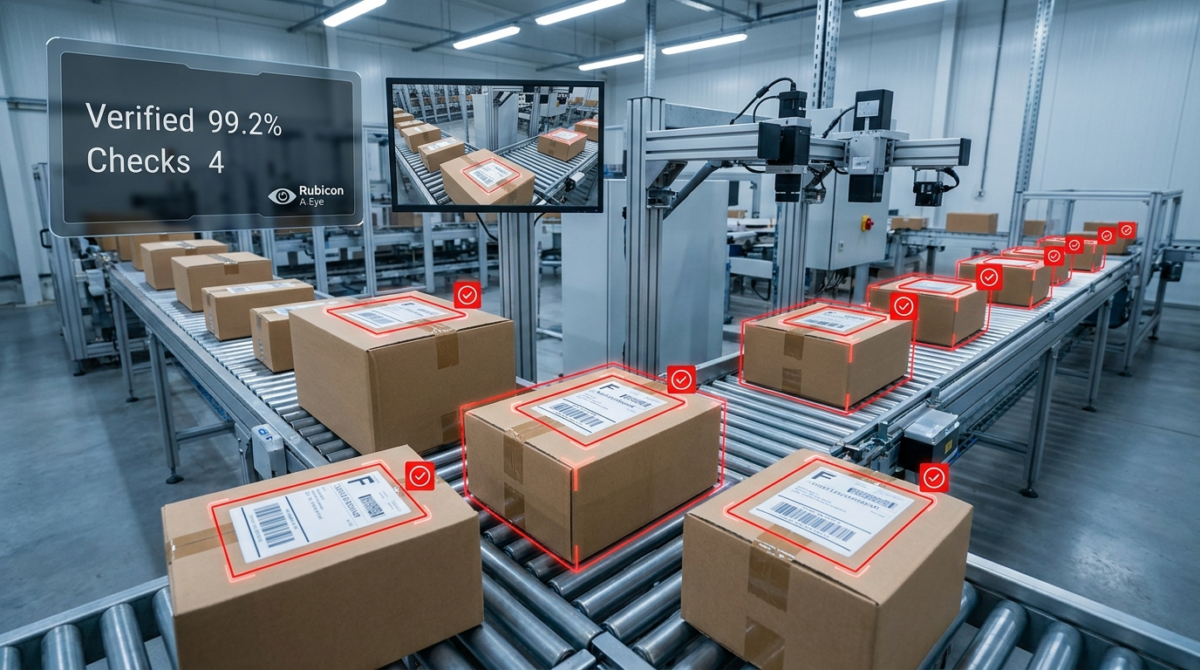
Real-time inspection of packaging completeness—verifying labels, seals, tape, and box integrity before shipment, eliminating manual audits and reducing customer complaints from incomplete or damaged packages.
The Packaging Challenge
Your Current Reality
- Manual inspection at packing station (100% check) requires 15–30 sec per box; bottleneck on fast lines.
- Inspector fatigue leads to 5–10% miss rate on labels, missing seals, or open cartons.
- Customer complaints post-shipment (“label was torn,” “carton was open”) create warranty claims and return freight.
- No real-time visibility into packing defects; issues discovered during delivery (10+ days after ship).
- Hidden cost: rework, return freight, customer credits, chargeback fees = 2–5% of COGS for e-commerce or food/pharma.
How Packaging Verification Solves It
A-Eye’s Packaging Verification uses multi-class object and condition detection to inspect package completeness:
- Label Detection: Identifies presence, placement, and readability of shipping labels, expiration dates, regulatory markings.
- Seal & Tape Assessment: Detects presence, integrity, and proper coverage of tamper-evident seals, tape, or box tape.
- Box Condition Check: Identifies damage (crushed, dented, puncture) and flags for rework or downgrade (if minor).
Key Capabilities
Label Presence & Placement
Verifies shipping label (or product label) is present on box and positioned correctly. Flags missing, upside-down, or partially applied labels.
Seal Integrity
Detects tamper-evident seals, safety tape, or security stickers; flags if missing, partially open, or misaligned.
Barcode Readability
Verifies barcodes/QR codes are visible, not obscured or damaged, enabling downstream scanning without failures.
Box Condition Assessment
Classifies box state: pristine, minor damage (cosmetic), or severe (crush/puncture). Enables routing to rework or discount channels.
Multi-Sided Inspection
If integrated with multi-camera setup, inspects top, sides, and front; ensures all required markings are present and visible.
High-Speed Processing
Processes up to 600 boxes/hour without slowing packing line; integrates with conveyor handoff automation.
What You Can Measure
Industry Applications
Business Benefits
Operational Workflow
Example Scenarios
Scenario 1: Missing Label Detection
Situation: E-commerce fulfillment line. A package is sealed without shipping label (labeler jam). Inspector would miss it ~40% of the time due to fatigue.
Without A-Eye: Unlabeled box ships with next batch. Carrier receives unprocessable parcel. Customer’s order delayed 2–3 days. Complaint issued; refund processed.
With A-Eye: Inspection triggers within 2 sec of box arrival at camera. “Label missing” alert. Gate redirects box to rework station. Labeling completes within 30 sec. Result: Ship delay prevented; customer satisfaction maintained.
Scenario 2: Seal Integrity Verification
Situation: Food packaging line (tamper-evident seals). Seal applicator misaligns on ~3% of boxes, leaving seal partially open. Manual inspector catches ~85%.
Without A-Eye: 15% of improperly sealed boxes ship. Customer opens package, sees seal partially lifted, perceives tampering. Return filed; product destroyed per company policy. COGS loss: ~$8 per box × 5% = significant shrinkage.
With A-Eye: Detects partial seals consistently. All rejected boxes rerouted to re-sealing station. 99%+ compliance verified. Result: Zero tamper-related returns; brand trust maintained.
Scenario 3: Barcode Readability
Situation: E-commerce distribution center packing 500 boxes/hour. 2% of labels are applied with barcode partially obscured (tape overlap, label wrinkle).
Without A-Eye: Carrier’s barcode scanner fails at first contact; box manually hand-sorted. Facility holds box 1–2 hours before rescanning. Shipment delays; some orders miss promised delivery window.
With A-Eye: Flags obscured barcodes pre-ship. Operator adjusts label position before sealing. All barcodes verified readable. Result: 100% carrier scanning success; on-time delivery rate improves 3%.
Scenario 4: Box Damage Triage
Situation: Cosmetics manufacturer ships premium skincare products. Packaging lines produce occasional crushed corners (from conveyor pressure). Boxes are still functional but aesthetically compromised.
Without A-Eye: All boxes shipped as-is; customer receives visibly damaged packaging. Return rate: 4% (customer perception of poor quality). Discounts issued; margin erodes.
With A-Eye: Detects crushed boxes; routes to “second quality” channel (discount tier, gift-with-purchase, or corporate giveaway). Premium boxes (perfect condition) ship at full price. Result: Returns drop to 0.5%; revenue optimized via channel routing.
Integration & Data Flow
| System | Integration Method | Data Shared |
|---|---|---|
| Conveyor / Diverter | GPIO or Modbus command | Pass/Fail signal → divert gate to rework or shipping |
| WMS / Shipping | REST API or EDI | Inspection result, defect type, box ID/tracking |
| ERP | CSV export or scheduled API | QA metrics, defect rate, rework count by shift |
| Mobile App | WebSocket (live updates) | Live inspection rate, pass %, defect alerts |
| Slack / SMS | Native alert channel | High defect rate alerts (e.g., >10% fails in 1 hour) |
Frequently Asked Questions
Can A-Eye inspect boxes moving at high speeds?
Yes. A-Eye processes at 30 FPS and can inspect up to 600 boxes/hour. For faster lines (>1000 boxes/hour), use dual cameras with offset triggers. Typical analysis time per box: <500 ms.
How does A-Eye handle different label sizes and designs?
A-Eye learns label geometry during setup (100–200 sample images). Once trained, it recognizes your labels at any position/angle on the box. If you change label design, re-train with 30–50 new samples (~15 min).
Can A-Eye read and verify barcode content (not just visibility)?
Yes. A-Eye can decode 1D (Code128, UPC) and 2D (QR, DataMatrix) barcodes. You can verify content matches expected SKU/lot number; alerts on mismatch. Optional: compare barcode to shipping label SKU for reconciliation.
How does A-Eye detect different seal types (tape vs. sticker vs. tape+seal)?
A-Eye learns your facility’s seal types during training. It can distinguish tape (clear packing tape), tamper-evident stickers, security tape (with color), and hybrid approaches. Rules allow mixed-seal scenarios (e.g., “top AND side seals required”).
What if a box has cosmetic damage but is still shippable?
A-Eye classifies damage severity: pristine, minor (cosmetic dent/crease), moderate (visible puncture), severe (crushed/open). You configure thresholds: e.g., “minor → second-quality channel, severe → scrap.” Enables revenue optimization.
Can A-Eye handle multi-sided inspection (top, sides, front)?
Yes. Deploy 2–3 cameras around the box (top/front/side view). A-Eye merges results: e.g., “label present on top AND side” requirement. Ensures all regulatory markings are visible no matter orientation.
How does A-Eye verify regulatory markings (e.g., “Made in China”)?
A-Eye can detect text on labels via OCR (optical character recognition). You configure rules to verify presence of required text (e.g., “Made in” + country). Alerts if text is missing or illegible. Typical accuracy: 95% for standard fonts.
What’s the false-positive rate for seal detection?
Typical false-positive rate: 2–4%. Common causes: box wrinkles mimicking open seals, reflective tape edges. All “fail” results can be reviewed by supervisor before rework is triggered; we can tune thresholds to reduce false positives.
Can I export inspection data for compliance audits?
Yes. A-Eye generates daily/weekly inspection reports: timestamp, box ID, inspection result, defect type (if any), image snapshot. Exportable as PDF, CSV, or JSON. OSHA/FDA-audit-ready with full traceability.
How much will Packaging Verification cost?
A-Eye Pro tier includes Packaging Verification ($12,500/year for 1–5 lines). Enterprise tier ($40,000+/year) includes unlimited lines, multi-camera setups, and OCR/barcode decoding. Setup includes rule configuration and model training. Request a quote.
Is on-premise processing available for sensitive products?
Yes. A-Eye offers edge deployment for on-premise processing (pharmaceutical, food, defense). All inspections happen locally on your GPU; no data leaves the facility. Cloud sync is optional.