

Manufacturing AI
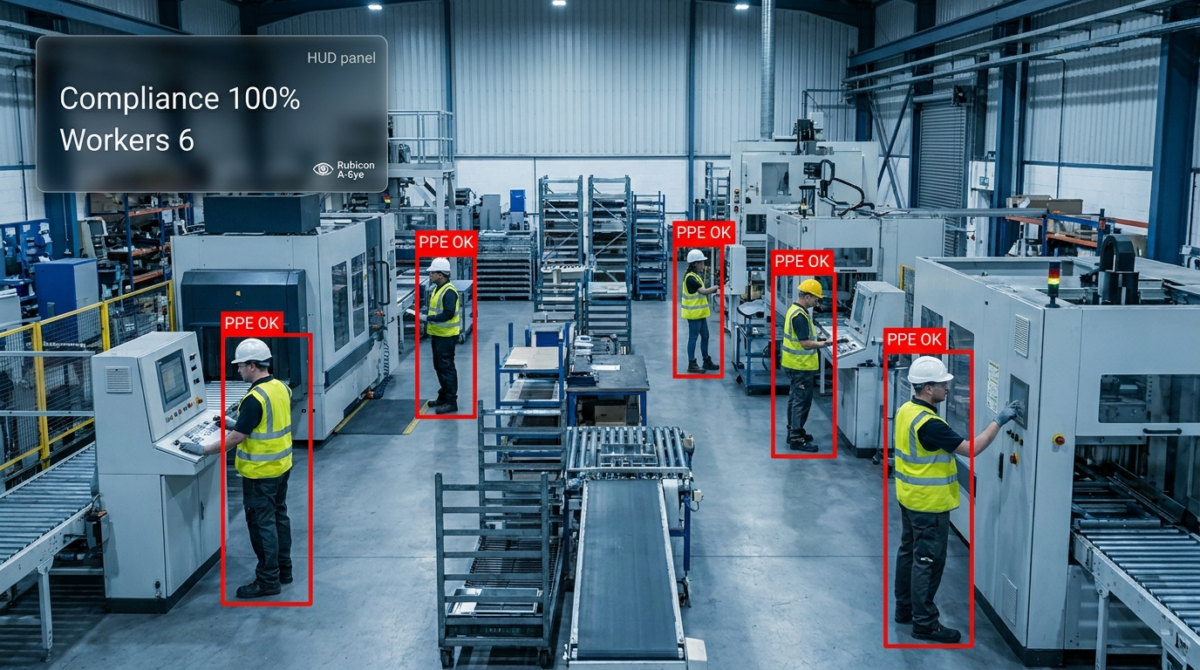
Safety audits happen periodically; the risk they check for is constant. Rubicon A-Eye continuously checks that required protective equipment — helmets, hi-vis vests, gloves — is worn in the zones you define, supporting your safety team with timely visibility rather than retrospective spot checks.
The business challenge
Most plant safety programmes rely on scheduled walk-throughs, periodic audits and incident reports. These are necessary, but they all share the same limitation: they check compliance at a point in time, while the conditions that lead to an incident exist continuously, every hour the floor is operating. A zone that is fully compliant during a Tuesday morning audit can have multiple PPE gaps by Tuesday afternoon, and nobody knows until the next scheduled check, or until something goes wrong.
This is not a question of effort from the safety team. It is a structural limitation of periodic checking applied to a continuous risk. A supervisor walking the floor cannot be everywhere at once, and a safety officer reviewing CCTV after an incident is working with evidence, not prevention. The result is a safety programme that can document what happened, but struggles to consistently catch what is happening right now, in real time, across every zone that matters.
For a plant safety manager, this shows up as a familiar set of problems:
- Compliance verified only during scheduled audits, with long gaps between checks
- PPE gaps discovered after an incident rather than before one
- No consistent record of compliance trends across zones, shifts or time of day
- Safety officer time consumed reviewing footage manually after the fact
- Difficulty demonstrating proactive compliance to auditors or clients
- Inconsistent enforcement between shifts and supervisors
The hidden cost of periodic checking
The cost of a safety gap is rarely visible until it becomes an incident, and by then the cost has shifted from preventable to consequential — injury, downtime, investigation, and the broader cost to morale and reputation. Even short of an incident, a safety programme built on periodic checks struggles to show continuous improvement, because it only has data points from the moments it happened to be looking. Audit and insurance conversations both benefit from a continuous record rather than a handful of scheduled snapshots, and that record is exactly what periodic checking cannot produce on its own.
How Rubicon A-Eye solves the problem
A-Eye treats PPE compliance as a continuous visibility problem rather than a scheduled audit task. Cameras with a view of the zones you designate — production floor, specific machinery areas, loading zones — feed an on-site edge device that checks for the presence of required protective equipment continuously, for as long as the zone is active.
This is explicitly a safety-compliance support tool, not an individual worker-surveillance system. The purpose is to identify gaps in protective equipment in defined zones so they can be addressed quickly and consistently, supporting the safety culture your team is already building — not to track, score or penalise individuals. The output is a zone-level compliance signal and an alert when PPE is missing in a monitored area, processed on-site so footage never leaves your facility.
Because checking is continuous rather than scheduled, gaps are flagged close to when they occur, giving supervisors the chance to address them proactively. Over time, the accumulated record also gives the safety team something a single audit cannot: a documented compliance trend across zones and shifts, useful for both internal improvement and external audit conversations.
Key capabilities
Continuous zone monitoring
PPE presence checked continuously in defined zones, rather than only during scheduled walk-throughs.
Configurable PPE requirements
Set the specific equipment required per zone — helmets, hi-vis vests, gloves, eye protection — matched to your actual safety policy.
Proactive alerts
Flag missing PPE while the gap exists, giving supervisors the chance to address it before it leads to an incident.
On-site processing
Detection runs on an edge device inside your facility; footage stays on-premise, supporting privacy expectations.
Compliance trend record
Build a documented history of zone-level compliance over time, useful for internal review and external audits.
Multi-zone coverage
Monitor multiple zones with different PPE requirements simultaneously, each configured to its own policy.
What you can measure
- PPE compliance rate by zone, shift and time of day
- Frequency and duration of compliance gaps before they are addressed
- Trends in compliance over weeks and months, by zone
- Response time from alert to gap being resolved
- Zones with recurring compliance issues, indicating where reinforcement is needed
- Coverage of monitored zones against total safety-critical areas
Industry applications
PPE detection is most valuable in zones with defined, consistent equipment requirements and meaningful injury risk — machinery areas, loading docks, zones with overhead hazards, and any site where safety compliance is also a contractual or audit requirement for clients and insurers.
Business benefits
- Earlier identification of PPE gaps, supporting prevention rather than after-the-fact response
- A continuous compliance record rather than isolated audit snapshots
- Less safety officer time spent manually reviewing footage after incidents
- More consistent enforcement of PPE policy across shifts and supervisors
- Stronger documentation to support audits, certifications and client safety requirements
- Data that helps target safety reinforcement at the zones and shifts that need it most
- A safety programme built on continuous visibility rather than periodic spot checks
How it works: the operational workflow
Example scenarios
Catching a gap between scheduled audits
A zone passes its weekly safety walk-through, but two days later a contractor enters without a hard hat during an unscheduled task. A-Eye flags the missing PPE within the zone almost immediately, and the supervisor addresses it well before the next scheduled audit would have caught it.
Result: a gap closed in minutes instead of persisting for days.
Identifying a recurring shift pattern
Compliance data accumulated over a month shows one specific shift has a noticeably higher rate of missing hi-vis vests in the loading zone than other shifts. The safety team targets a brief refresher with that shift rather than a plant-wide reminder.
Result: reinforcement focused where the data shows it is actually needed.
Supporting an external audit
A client safety audit asks for evidence of ongoing PPE compliance, not just a policy document. The plant provides the accumulated zone-level compliance trend from A-Eye, showing continuous monitoring rather than a single inspection day.
Result: audit evidence based on continuous data, not a one-time snapshot.
Reducing manual footage review
After a near-miss, the safety officer previously would have reviewed hours of footage manually to understand PPE conditions at the time. A-Eye’s logged compliance events for that zone and time window are already available, cutting the review to minutes.
Result: investigation time reduced through an existing, searchable event record.
Integration with your systems
| System | How A-Eye connects |
|---|---|
| Safety / HSE systems | Compliance events and trends feed your existing safety reporting and incident-review processes. |
| Dashboards | Live zone compliance status displayed for safety officers and supervisors during operating hours. |
| Odoo (general operations) | Safety events sit alongside production and other operational data for a unified plant view. |
| Reporting systems | Compliance-rate trends exported for audits, certifications and management safety reviews. |
Implementation and rollout
Deployment is designed to support your existing safety programme, not to disrupt it, and to build trust in the system before alerts drive action. A typical rollout follows four stages:
During validation, A-Eye runs alongside your existing audit schedule so the safety team can compare what it flags against what a scheduled walk-through would catch, confirming the system reflects your actual policy before alerts are acted on operationally. Only once that confidence is established does the team begin treating A-Eye alerts as the primary, continuous signal, with scheduled audits continuing as a complementary check. Because the system uses existing cameras and on-site processing, rollout is typically measured in weeks, often starting with the highest-risk zone before expanding to the rest of the facility.
A point worth being explicit about during rollout: this is introduced to the workforce as a safety-compliance support tool, with the framing communicated clearly from the outset. Sites that roll this out successfully tend to involve the safety committee or worker representatives early, explaining that the system flags zone conditions to help close gaps quickly, not to track or penalise specific individuals. That framing, set consistently from day one, is part of why the tool supports rather than undermines the existing safety culture on the floor.
Continuous PPE visibility also changes how a safety team can plan its time. Rather than spreading limited audit hours evenly across every zone regardless of actual risk, a safety officer can use the accumulated compliance trend to direct walk-throughs and toolbox talks toward the zones and shifts where the data shows gaps recur, while spending less time re-checking zones that consistently comply. The result is a safety programme that allocates its most limited resource — people’s attention — based on where the evidence says it is needed, rather than on a fixed rotation that treats every zone as equally likely to have an issue.
Frequently asked questions
Is this about monitoring individual workers?
Which PPE items can it detect?
Does footage leave the site?
Can different zones have different PPE requirements?
How quickly are gaps flagged?
Will this replace our safety officers or audits?
Can it help with client or certification audits?
How accurate is PPE detection?
What happens with contractors or visitors who aren’t regular staff?
Can it cover outdoor areas like loading docks?
How long does implementation take?
What happens if a camera goes offline?
See proactive PPE compliance support on a plant like yours
Book a demo or a no-obligation site assessment and we will show A-Eye running against your safety zones.