

Warehouse AI
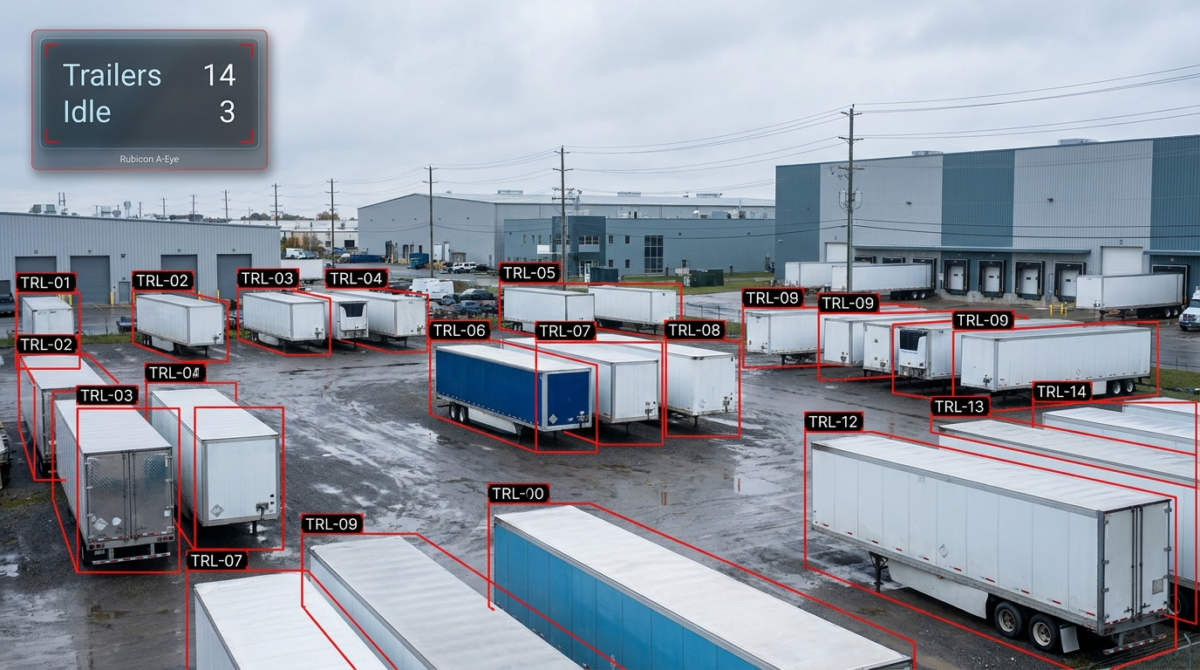
A trailer parked in the wrong corner of the yard is invisible to everyone except the person who happens to walk past it. Rubicon A-Eye tracks every trailer across your yard and dock through the cameras you already have, so location, loaded or empty status, and time on site are always known — not rediscovered by accident.
The business challenge
A yard full of trailers looks, to most management systems, like a list of trailer numbers with no reliable link to where each one actually is. Trailers get dropped off, parked in whatever spot was free at the time, and left until someone needs them — at which point finding the right one becomes a manual search across a yard that may hold dozens of units. Multiply this by multiple shifts, multiple gate staff, and a yard layout that changes by the hour, and the result is an operation that loses track of its own assets in its own facility.
The deeper issue is that trailer location and status are usually only known at two points: when a trailer enters through the gate, and when someone goes looking for it. Everything in between — where it was moved to, whether it has been loaded or emptied, how long it has actually been sitting — depends on someone remembering to update a whiteboard, a spreadsheet, or a yard management system that requires manual entry every time a trailer moves. In practice, that update happens inconsistently, and the system drifts from the yard within hours.
For yard and dispatch teams, this produces a recognisable set of daily frustrations:
- Time spent physically walking or driving the yard to locate a specific trailer
- Trailers that sit forgotten in a corner of the yard for days, tying up yard space and the trailer itself
- No reliable way to tell, without inspection, whether a parked trailer is loaded, empty, or partially loaded
- Detention charges accumulating on trailers nobody realised had been on site so long
- Conflicting information between the yard board, the gate log and what is physically in the yard
- Dispatch planning delayed by uncertainty over which trailers are actually available and where
The hidden cost of an untracked yard
A trailer that cannot be found is, for as long as it is lost, functionally the same as a trailer the operation does not own — except it is still costing money in detention, yard space and idle capital. The search time itself is a direct labour cost, repeated every time a trailer is needed urgently. But the larger cost is the planning paralysis it creates: when nobody trusts the yard board to reflect reality, dispatch starts padding schedules with safety margin, assuming trailers will need to be found and prepared later than planned. Detention charges compound this quietly, accumulating on units that simply slipped from anyone’s attention once they were parked. None of this shows up as a single failure — it shows up as a yard that always seems busier and more constrained than the trailer count alone would suggest.
How Rubicon A-Eye solves the problem
A-Eye treats the yard as a set of continuously monitored zones rather than a list of trailers that someone has to manually account for. Cameras covering the yard, parking areas and dock approach feed an on-site edge device that identifies trailer presence, location within the yard, and changes in status as they happen — without requiring a gate scan, manual log entry or radio call to register the information.
All processing runs on a device inside your facility. Footage never leaves the site; only the location and status data it produces — where each trailer is, how long it has been there, whether its loaded or empty state has changed — flows onward to your dashboards and Odoo. This keeps the system aligned with data-privacy expectations and keeps bandwidth costs near zero, since no video is streamed off-premise.
The practical effect is that the yard becomes searchable. A dispatcher can see, on a dashboard, where every monitored trailer currently sits and how long it has been there, instead of sending someone to walk the yard. When a trailer needs to move to a bay, the system already knows where it is. When a unit has been parked far longer than expected, that fact surfaces on its own rather than waiting for someone to notice a detention invoice.
Key capabilities
Live yard location
See where each monitored trailer is currently parked across the yard, dock approach and staging areas, without a physical search.
On-site dwell tracking
Know exactly how long each trailer has been on site since arrival, continuously updated rather than estimated from a gate log.
Loaded / empty status signals
Identify changes consistent with a trailer being loaded or emptied, helping distinguish active inventory from idle empties.
Dock assignment visibility
Track which trailers are currently assigned to or waiting for a dock door, connecting yard status to bay activity.
Overdue trailer alerts
Flag trailers approaching or exceeding expected on-site time before they become a detention surprise.
Yard congestion view
See how trailers are distributed across the yard to identify congestion points and improve parking discipline.
What you can measure
- Current location of every monitored trailer across the yard, continuously
- Dwell time per trailer from arrival to departure
- Loaded versus empty status changes over time
- Trailers approaching or exceeding a defined detention threshold
- Yard occupancy and congestion by zone
- Time spent searching for or relocating trailers, trending downward as visibility improves
Industry applications
Trailer tracking matters anywhere trailers accumulate in a yard faster than they can be visually accounted for. In the UAE and wider GCC, it is especially relevant for:
For 3PLs managing trailers on behalf of multiple clients, accurate location and dwell data underpins both billing accuracy and service reporting. In high-volume distribution yards, where dozens of trailers can be on site at once, visibility prevents the slow accumulation of forgotten units. In any operation paying detention charges, dwell tracking turns an after-the-fact invoice dispute into a before-the-fact alert.
Business benefits
- Less time spent physically searching the yard for a specific trailer
- Earlier warning on trailers approaching detention thresholds
- Better use of yard space through visibility of where trailers are parked
- Fewer forgotten trailers sitting idle for days without anyone noticing
- More accurate dispatch planning based on real trailer availability and location
- A reliable record to reconcile against carrier and client billing
- Improved coordination between yard, gate and dock teams around shared trailer status
How it works: the operational workflow
The flow from a camera view of the yard to a dispatcher’s screen is continuous, so trailer status never depends on someone remembering to update a board.
Example scenarios
Finding a trailer without walking the yard
A dispatcher needs a specific trailer for an urgent outbound load but has no record of exactly where it was parked two days earlier. The yard dashboard shows its current location immediately, and a yard truck is sent directly to it instead of someone driving the rows looking for the unit.
Result: a load dispatched within minutes instead of after a search across the yard.
Catching a trailer before detention kicks in
A trailer dropped off for unloading is parked in a far corner and, in the busy schedule, is forgotten. A-Eye’s dwell tracking shows it approaching the carrier’s free time threshold and raises an alert. The team prioritises it that afternoon, avoiding the detention charge that would otherwise have appeared on the next invoice with no warning.
Result: a detention charge avoided because the overdue trailer surfaced on its own.
Reconciling a billing dispute with a client
A 3PL client disputes how many days a trailer was held on site awaiting their instructions. The location and dwell record shows the exact arrival date and the date it was moved to the dock for loading, settling the question with a timestamped record rather than a remembered estimate.
Result: a billing dispute resolved in minutes with an objective record.
Reducing yard congestion during a peak period
During a high-volume week, the yard map shows trailers clustering near the gate because drivers default to the first available space rather than the most appropriate one. Yard staff use the live view to redirect parking toward underused rows, easing congestion near the dock approach without adding yard space.
Result: smoother yard flow during peak volume, using the same footprint.
Integration with your systems
Trailer location and status data earns its value once it reaches the people planning dispatch, yard moves and client billing. As a certified Odoo partner and AI engineering team, Rubicon builds this connection as part of the solution.
| System | How A-Eye connects |
|---|---|
| Odoo ERP / Logistics & Inventory | Trailer location, dwell and status events update logistics records and can trigger relocation or dispatch tasks. |
| Yard management | Live trailer map supports parking discipline and faster yard-truck dispatch to specific units. |
| Dashboards | Real-time yard map and trailer dwell view for dispatchers and yard supervisors. |
| Billing & reporting | Timestamped location and dwell records exported for detention reconciliation and client reporting. |
Frequently asked questions
Do we need new cameras across the yard?
Can it read trailer numbers or plates?
Does it cover open, uncovered yards?
How does it tell a loaded trailer from an empty one?
Does this replace our yard management system?
Can it alert us before detention charges apply?
Where is the video processed?
How many trailers can it track at once?
Will it work with our existing Odoo setup?
How long does implementation take?
Can this help with client billing disputes for trailer detention?
What happens if a camera covering part of the yard goes offline?
See real-time trailer tracking on a yard like yours
Book a demo or a no-obligation site assessment and we will show A-Eye running against your yard and your Odoo.