

Warehouse AI
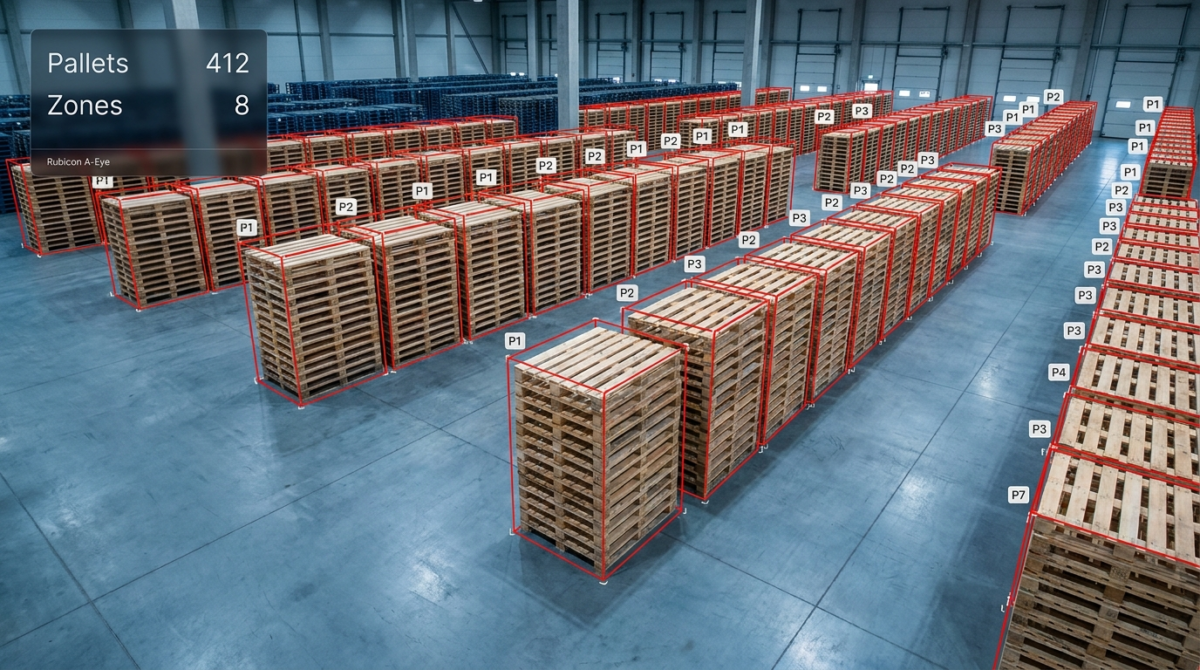
The pallet count is one of the most repeated and least reliable tasks in a warehouse. Rubicon A-Eye counts pallets automatically and continuously by zone, so you always have a current number to plan capacity, dispatch and reconciliation against — without sending anyone to walk the floor.
The business challenge
Knowing how many pallets are on the floor, and where, sounds simple. In practice it is a constant source of friction. Counts are done by people walking the aisles with a clipboard or scanner, and the number is out of date the moment they finish. For operations that need to know capacity in real time — to accept inbound loads, plan dispatch, or bill for storage — that lag is a real constraint.
Manual pallet counting creates a recurring set of operational pains:
- Counts are slow, tying up staff who could be picking or putting away
- The number is stale immediately, so capacity decisions rely on guesswork
- Human counting errors lead to disputes and reconciliation work
- 3PLs struggle to bill storage accurately without a trusted live count
- Inbound loads are accepted or refused without knowing true free space
- Zone-level occupancy is rarely known, so space is used inefficiently
The hidden cost of manual counting
A pallet walk looks cheap — an hour of someone’s time — but the real cost is in the decisions made around it. Because the count is only done periodically, capacity decisions in between are made blind: loads are refused that could have been accepted, or accepted into space that was not really there, causing congestion and rework. For contract logistics operations, an untrusted count directly threatens revenue, because storage billing rests on it. And every counting error feeds a cycle of disputes and reconciliation that consumes supervisor time. The clipboard is not the cost; the blind decisions and disputes around it are.
How Rubicon A-Eye solves the problem
A-Eye detects and counts pallets directly from your warehouse cameras, continuously. Rather than a person establishing a number once a shift, the system maintains a live count for every monitored zone and updates it as pallets arrive, move and leave. The result is a number your team can actually trust and act on at any moment.
Processing runs on an on-site edge device, so video stays in the building and only the counts are shared with your systems. The model is tuned during setup to your storage style — floor-stacked, block-stacked or racked — and to your camera angles and lighting, so dense or visually similar pallets are handled reliably.
Because the count is continuous and zone-aware, it becomes far more than a total. You can see how full each area is, how occupancy trends through the day and week, and how physical pallets reconcile against your system records. That makes pallet count a live planning input rather than a periodic audit number.
Key capabilities
Continuous pallet counts
A live total that stays current as pallets move, with no manual walk required at any point in the shift.
Zone-level breakdown
Counts split by the areas you define, so you know occupancy where it matters for planning and billing.
Capacity visibility
See how full each zone is and how much free space remains before accepting inbound loads.
Occupancy trends
Understand how pallet volumes rise and fall across shifts and days for better resource and space planning.
System reconciliation
Compare the physical pallet count to system records to catch and resolve gaps before they grow.
Storage-billing support
For 3PLs, a trusted continuous count underpins accurate, defensible storage billing and dispute resolution.
What you can measure
A continuous count turns capacity from a guess into a managed metric:
- Live pallet count and percentage occupancy per zone
- Free space available for inbound planning at any moment
- Occupancy trends and peak-period patterns over time
- Counting labour hours eliminated versus the manual process
- Reconciliation gaps between physical and system counts
- Storage utilisation for billing and space-optimisation reporting
Industry applications
Automated pallet counting is valuable wherever pallets are the unit of storage and capacity is a live concern:
3PL and contract logistics operations benefit most directly, because for them pallet count is tied to both capacity decisions and revenue. Cold storage operators gain by minimising time staff spend counting in chilled environments. Import and re-export operations, where pallet volumes swing sharply, use the live count to manage volatile capacity without over- or under-committing space.
Business benefits
- Eliminate the labour spent on manual pallet walks
- Make capacity decisions on a current, trusted number
- Accept or schedule inbound loads with confidence in free space
- Reduce counting disputes and reconciliation effort
- Improve space utilisation through zone-level occupancy data
- Support accurate, defensible storage billing for contract logistics
How it works: the operational workflow
Example scenarios
Accepting an unplanned inbound load
A customer asks a 3PL to take an extra inbound shipment at short notice. Instead of sending someone to check free space, the duty manager reads the live zone occupancy from A-Eye, confirms capacity in a specific zone, and accepts the load with confidence.
Result: a revenue opportunity captured in minutes, not refused out of caution.
Resolving a storage-billing dispute
A customer queries a storage invoice. Because A-Eye has maintained a continuous, zone-level pallet count, the 3PL can show occupancy over the billing period rather than relying on spot counts, and the dispute is settled on evidence.
Result: faster resolution and protected revenue.
Rebalancing congested zones
Occupancy trends reveal that one zone repeatedly hits capacity while another sits half-empty. The team adjusts put-away rules to balance the load, improving pick efficiency and reducing congestion.
Result: better use of existing space without new racking.
Planning dispatch against real volume
A supervisor planning the afternoon dispatch sees from the live count exactly how many pallets are staged in the outbound zone, and schedules vehicles and labour to match — rather than discovering a mismatch when trucks arrive.
Result: dispatch resourced accurately to actual volume.
Implementation and rollout
Pallet counting is quick to stand up because it builds on cameras you already have. The rollout follows a clear path:
At commissioning we benchmark the live count against manual counts and tune until it meets your accuracy requirement, so you trust the number before you depend on it. Most operations then retire routine pallet walks, keeping only occasional spot checks. Deployment is typically measured in weeks.
Integration with your systems
Pallet counts are most useful connected to the systems where capacity and stock decisions are made.
| System | How A-Eye connects |
|---|---|
| Odoo ERP / Inventory | Zone occupancy and counts inform capacity context and reconcile against stock records. |
| Warehouse management (WMS) | Physical pallet counts complement system locations and flag discrepancies. |
| Dashboards | Live occupancy by zone for planners and duty managers. |
| Billing / reporting | Occupancy data supports storage billing and management reporting. |
Why camera-based counting outperforms the alternatives
Operations that want a better pallet count usually weigh three options: count more often by hand, tag everything with RFID, or fit sensors. Each has real drawbacks. Counting more often simply multiplies the labour and still produces a number that is stale the moment it is taken. RFID can work, but it requires tagging every pallet, maintaining readers, and absorbing the cost and failure modes of the tags themselves — a significant programme for what is, in the end, a count. Fixed sensors only see the specific points they are installed at and rarely cover a whole storage area economically.
Camera-based counting sidesteps these trade-offs. It uses infrastructure you already own, requires nothing to be attached to the pallets, and covers whole zones rather than single points. Because it runs continuously on the edge device, it delivers a live number around the clock without adding labour, and it degrades gracefully — if one camera is obscured, only its zone is affected while the rest keep counting. For most UAE warehouses, it is the only approach that combines whole-floor coverage, continuous currency and a low cost of ownership.
Validating a count before a customer audit
Ahead of a client audit, a 3PL needs to confirm its stated pallet positions are correct. Instead of pulling staff for a full manual count, the team reviews the continuous A-Eye count by zone, reconciles the handful of discrepancies it surfaces, and walks into the audit with evidence rather than hope.
Result: audit-ready in hours, with no operational shutdown.
Built for UAE and GCC warehouse operations
Pallet-based storage dominates the UAE’s logistics, distribution and re-export sectors, where free zones and contract-logistics providers handle large, fluctuating pallet volumes for many clients at once. In that environment, capacity is both an operational constraint and a billable commodity, so a trusted live count is not a nice-to-have — it is the basis of how space is sold and used. A-Eye is designed to run on-site, keeping footage within the facility in line with UAE data-privacy expectations, and to operate reliably in the region’s large, high-bay and temperature-controlled warehouses.
Because the system is delivered by a team that also implements Odoo across UAE businesses, the pallet count does not sit in isolation. It connects to the same ERP that runs receiving, billing and reporting, so capacity data flows into the commercial and operational decisions it should inform. For multi-client 3PLs in particular, that connection — live physical count tied to client billing and capacity planning — is what turns continuous counting from a curiosity into a commercial advantage.
Frequently asked questions
Can it count pallets that are stacked or in racking?
What if pallets look similar or are tightly packed?
Can we get counts for specific zones?
Do we need new cameras?
How current is the count?
Can it replace manual counts entirely?
Is the video sent to the cloud?
Does it integrate with Odoo?
How is accuracy validated at go-live?
Can it distinguish empty pallets from loaded ones?
Does it work in cold storage?
What does it cost?
Always know your pallet count
See automated, zone-level pallet counting on a layout like yours.