

Warehouse AI
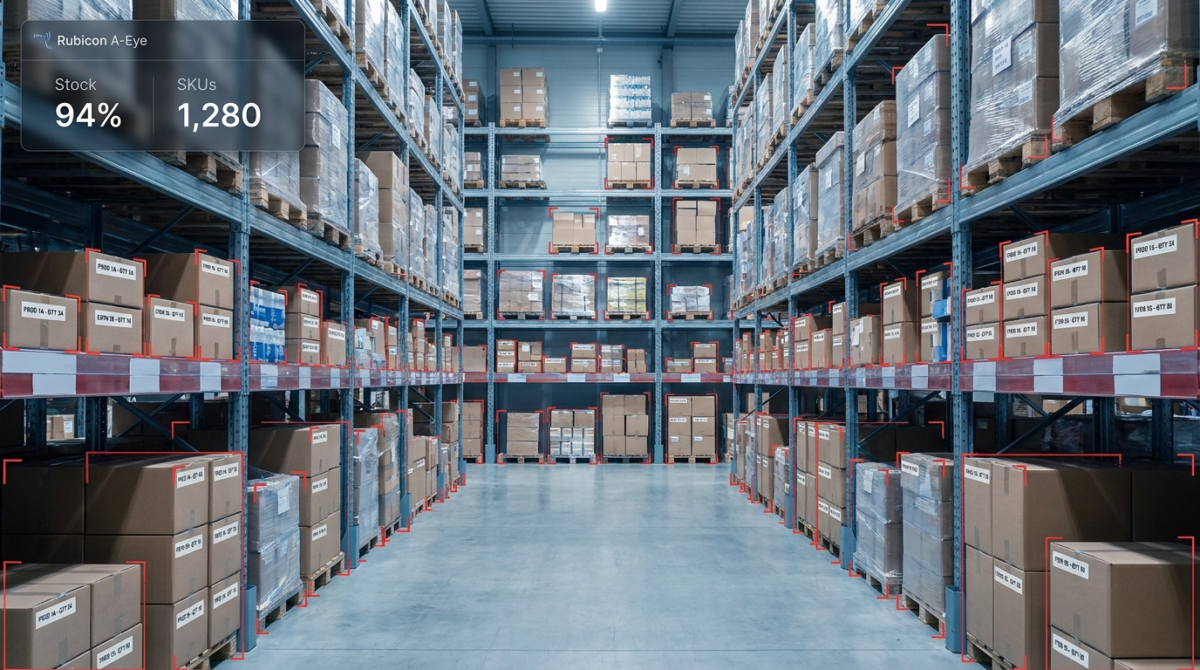
Most warehouses only know their true stock position on count day. Rubicon A-Eye monitors your storage zones continuously through the cameras you already have, so inventory levels are visible in real time and your Odoo records stay matched to what is physically on the floor.
The business challenge
Inventory accuracy is the foundation everything else in the warehouse depends on — picking, replenishment, purchasing, customer promises and financial reporting. Yet in most UAE distribution operations, the real stock position is only confirmed during periodic counts. Between those counts, the system drifts from reality, and the warehouse runs on numbers that are quietly wrong.
The root cause is that conventional systems only know what was scanned. A pallet put away in the wrong location, stock moved without a transaction, damage that was never logged, or a mis-keyed receipt all create a gap between the system and the shelf. By the time a count exposes the gap, the operational damage — a missed pick, an emergency purchase, an over-sold SKU — has already happened.
For a warehouse manager, this shows up as a familiar set of daily problems:
- Stock figures that staff no longer fully trust, so they double-check physically
- Stockouts of fast movers discovered only when a picker reaches an empty location
- Excess stock and overstock tying up space and capital in slow movers
- Disruptive full stock-takes that halt operations and still produce disputes
- Write-offs and adjustments with no clear explanation of where stock went
- Purchasing decisions made on inventory data that is days out of date
The hidden cost of inaccurate inventory
Every point of inventory inaccuracy resolves into one of two expensive outcomes. Either you believed you had stock you did not — and a customer order is short-shipped, back-ordered or lost — or you held stock you did not need, tying up cash and space in inventory that is not turning. Both happen continuously in an operation running on stale numbers, and both are largely invisible until a count or a service failure brings them to the surface. Add the labour cost of the counts themselves, the management time lost to investigating discrepancies, and the erosion of trust that pushes staff back to manual checks, and the true cost of inaccuracy is far larger than the write-off line in the accounts suggests.
How Rubicon A-Eye solves the problem
A-Eye treats inventory monitoring as a continuous observation problem rather than a periodic counting task. Cameras with a view of your racking and storage zones feed an on-site edge device that interprets what is in each zone — whether locations are full, partially filled or empty, and when those states change. Instead of a single snapshot on count day, you get a live, always-current picture of stock distribution across the facility.
The processing runs on a small computer inside your warehouse, not in the cloud. Footage never leaves the site, which keeps you aligned with UAE data-privacy expectations and removes the bandwidth cost of streaming video off-premise. The output — zone states, level changes, low-stock conditions — is the only thing that travels, and it travels straight into your operational systems.
Crucially, A-Eye does not replace your barcode or WMS processes; it complements them. Scans remain the system of record for individual transactions, while A-Eye provides the continuous physical ground-truth that catches what scans miss. Where the two disagree, you have an early signal to investigate — long before a count would have surfaced it. Over time, this continuous reconciliation stops the slow drift that erodes accuracy between counts, so the system stays close to reality by default rather than being corrected after the fact.
Key capabilities
Live zone-level visibility
See fill state for every monitored location and zone in real time, without sending anyone to walk the aisles or interrupt other work.
Low-stock detection
Get notified the moment a pickable location drops below a defined threshold, so replenishment happens before the stockout, not after.
Empty-location alerts
Identify locations that have emptied unexpectedly, flagging both replenishment needs and possible put-away or picking errors.
Stock-distribution view
Understand how stock is spread across zones to improve slotting, space use and pick-path efficiency.
Discrepancy signals
Surface mismatches between the physical view and system records as they arise, enabling investigation in days not months.
Continuous count support
Reduce reliance on disruptive full stock-takes by maintaining a trusted live view that lightweight cycle checks can confirm.
What you can measure
Continuous monitoring turns inventory from an occasional audit into a set of live operational metrics managers can act on every shift:
- Inventory accuracy maintained continuously, with discrepancy rates trending over time
- Stockout incidents and their duration by SKU and zone
- Low-stock alerts raised and replenishment response times
- Zone occupancy and space utilisation across the facility
- Counting labour hours saved against the previous process
- Adjustments and write-offs, with earlier root-cause attribution
Industry applications
Inventory monitoring applies anywhere physical stock is held at scale and accuracy matters to service and cost. In the UAE and wider GCC it is especially valuable for:
For 3PLs, accuracy underpins both service-level agreements and client trust. In FMCG and food distribution, fast turnover means the system drifts quickly, so continuous monitoring has an outsized effect. In trading and building materials, where high-value stock sits in bulk, early discrepancy detection protects margin. Operations with high SKU counts, fast turnover, or strict service-level commitments see the fastest return, because for them the gap between system and reality is both larger and more expensive.
Business benefits
The value of continuous inventory monitoring is practical and measurable. Operations that adopt it typically target:
- Higher inventory accuracy maintained continuously, not just after counts
- Fewer stockouts of fast-moving lines and the lost sales they cause
- Reduced labour spent on manual counting and re-counting
- Less disruption from full stock-takes that stop operations
- Lower write-offs through earlier detection of discrepancies
- Better purchasing and replenishment decisions from current data
- Improved space utilisation through visibility of stock distribution
How it works: the operational workflow
The path from a camera frame to a manager taking action is deliberately short. A-Eye is designed so that what it sees becomes an operational event in your systems, not just a chart on a wall.
Example scenarios
Preventing a fast-mover stockout
A high-velocity SKU in a pick face is drawing down faster than usual during a promotion. A-Eye detects the location crossing its low threshold mid-shift and raises a replenishment task in Odoo. Stock is topped up from reserve before the face empties, so picking never stalls and the promotion is not under-served.
Result: stockout avoided without anyone manually patrolling the aisle.
Catching a put-away error early
A pallet is placed in the wrong location after receiving. The expected location stays empty while another fills unexpectedly. A-Eye flags both conditions, and the team corrects the put-away the same day — rather than discovering a phantom stockout when a picker is sent to the empty location next week.
Result: a discrepancy resolved in hours instead of surfacing as a failed pick.
Shrinking the annual stock-take
Because the live view is trusted, the operation moves from frequent full counts to targeted cycle checks of only the zones where A-Eye and the system disagree. The annual wall-to-wall count becomes a verification exercise rather than a multi-day shutdown.
Result: counting labour and operational downtime cut substantially.
Smarter purchasing decisions
A buyer is about to place a replenishment order based on a system figure. The live A-Eye view shows the reserve zone is fuller than the system believed, after a recent put-away that was never confirmed. The order is adjusted, avoiding an over-purchase that would have sat as excess stock for weeks.
Result: capital protected by buying against reality, not stale data.
Implementation and rollout
Deployment is designed to be low-disruption and to build trust before you rely on the system. A typical rollout follows four stages:
During validation, A-Eye runs alongside your existing counting process so you can compare the live view against known-good counts and tune until it meets your accuracy requirement. Only once the live view is trusted do you start reducing manual counts and acting on A-Eye events directly. Because the system uses existing cameras and on-site processing, the whole rollout is typically measured in weeks rather than months.
Integration with your systems
Inventory monitoring delivers its value when its output flows into the systems your team already works in. Because Rubicon is a certified Odoo partner as well as an AI engineering team, integration is treated as core to the solution, not an afterthought.
| System | How A-Eye connects |
|---|---|
| Odoo ERP / Inventory | Level changes and low-stock events update stock context and raise replenishment or internal-transfer tasks. |
| Warehouse management (WMS) | Physical zone states complement scan-based transactions, surfacing discrepancies for reconciliation. |
| Dashboards | Live inventory views and trends presented for supervisors and managers in real time. |
| Reporting systems | Accuracy, stockout and discrepancy metrics exported for operational and management reporting. |
Frequently asked questions
Do we need to install new cameras?
How accurate is camera-based inventory monitoring?
Does this replace our WMS or barcode scanning?
Can it monitor high racking and bulk storage?
Where is the video processed and stored?
How quickly are low-stock conditions detected?
Will it work with our existing Odoo setup?
How long does implementation take?
Can we keep our current counting process as a backup?
Does it handle products without barcodes or labels?
What happens if a camera goes offline?
Can multiple sites be monitored together?
What does it cost?
See real-time inventory monitoring on a warehouse like yours
Book a demo or a no-obligation site assessment and we will show A-Eye running against your zones and your Odoo.